Archive for May, 2013

Brothers Karamazov Summer Readalong!

Friday, May 31st, 2013

brosk

Nothing like flying by the seat of my pants, skin of my teeth, riding the ragged edge of disaster, la, la, la.

I’m reading Dostoevsky’s The Brothers Karamazov for one of my three book groups this summer, and I’d love it if you’d join me! I will even blog regularly so we can “talk” about it every week. I’m using the Pevear/Volokhonsky translation, but I bet any one would do as long as it’s divided into 13 books. Here’s the schedule. START NOW!

This Sunday, June 2, 2013: complete book 1. I’ll post to blog on Monday 6/3, and we can discuss in comments.

Sunday June 9, 2013, complete book 2. Discuss on Monday 6/10.

Sunday June 16, 2013 complete book 3. Discuss on Monday 6/17

Sunday June 23, complete book 4. Discuss on Monday 6/24

Sunday June 30 complete book 5. Discuss on Monday 7/1

Sunday July 7 complete book 6. Discuss Monday 7/8

Sunday July 14 complete book 7. Discuss Monday 7/15

Sunday July 21 complete book 8. Discuss Monday 7/22

Sunday July 28 complete book 9 Discuss Monday 7/29

Sunday August 4 complete book 10 Discuss Monday 8/5

Sunday August 11 complete book 11 Discuss Monday 8/12

Sunday August 18 complete book 12 Discuss Monday 8/19

Sunday August 25 complete book 13 and Introduction. Discuss Monday 8/26.

Books range from 20 pages long to 101, averaging 60. For this Sunday, it’s a mere 33 pages in my edition.

See? Totally do-able.

“Infidel” by Ayaan Hirsi Ali

Saturday, May 25th, 2013

I found Infidel by Ayaan Hirsi Ali a wildly uneven book, so my reaction falls between didn’t like (or, often hated) and it was OK. For me, effective memoirs are written by people with self insight and empathy, possibly leavened with humor. She’s writing about a difficult childhood and harsh reality for women abused in the name of Islam, so I’ll give her a pass that this book is humorless. But I find her lack of self-insight, her protestations of innocence in situations of obvious culpability, and her readiness to trot out other people’s horror stories in lieu of aforesaid self insight all pretty damning. The book is often poorly written with stunningly awkward transitions. Few if any other people stand out in the book because she is The Star. I found her disingenuous when claiming non-inflammatory intent when she over and over said incredibly outrageous things. This and other instances in the book led me not to believe her as a reliable narrator. Get thee to a therapist, I hope, to work out your childhood issues, especially with your father, and your inability to own your responsibility for your words and actions.

BUT, and it’s a huge BUT, she’s absolutely right that outrages against women and in general take place in the name of Allah, that this is sometimes (often?) ignored in the name of political correctness. She focuses more on this point at the end, so the book has a stronger finish that it does a beginning or middle.I found it unfortunate that she throws pretty much all of Islam under the bus in order to make this point. She makes an important argument, but one that is easier to dismiss because of the often offensive nonsense she surrounds it with.

This is a complicated book about complicated issues. It spurs me to find out more about Islam, but not by reading more of her writing.

Whither the Female in Post-Apoca-Fic?: “A Canticle for Leibowitz” and “Oryx and Crake”

Thursday, May 9th, 2013

Post-apoca-fic (PAF) is most recognized as a sub-genre of science fiction, but end-time narratives are at least as old as the Epic of Gilgamesh and the story of Noah’s ark. Modern PAF is marked as beginning with Mary Shelley’s The Last Man, written by a woman by featuring a male protagonist.
canticle

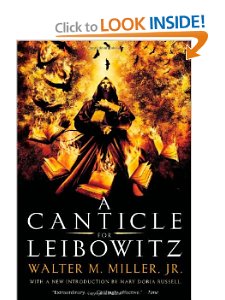
I recently re-read the PAF classic A Canticle for Leibowitz by Walter Miller, Jr. Published in book form in 1959, it collected 3 sections that had previously appeared in a sci-fi magazine. It centers on a monastery in post-nuclear Utah. There the monks seek canonization of the sacred Leibowitz of the title. A man of science instrumental in the nuclear holocaust of the mid 20th century, Leibowitz converted to Catholicism and advocated peace and learning. The book’s first section is set in the mid 21st century:

Brother Francis Gerard of Utah might never have discovered the blessed documents, had it not been for the pilgrim with girded loins who appeared during that young novice’s Lenten fast in the desert.

The subsequent sections jump ahead hundreds of years, though there are through lines for characters and artifacts that are fun and satisfying to recognize. I found the first section with Brother Francis, the most engaging. It’s the most funny, and Francis was my favorite of the many characters in the book. As the novel progresses, though, it shifts from being speculative to more preachy and explicative. The only females are in the third section, and this book fails The Bechdel Test, which identifies gender bias in fiction, in that no female has a conversation with another female.

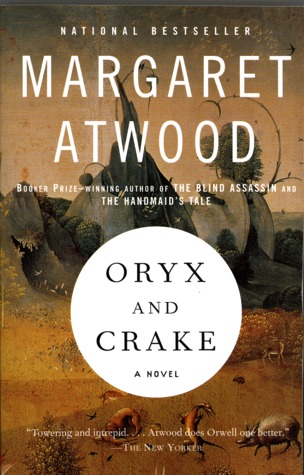
Since the book is set in a monastery, it could be argued that it wasn’t within the scope. Yet after I read this book, I longed for a female perspective, something like Margaret Atwood’s The Handmaid’s Tale. Since I hadn’t read her most recent post-apocalypse novels, I decided to check out Oryx and Crake, the first of the MaddAddam trilogy, which was followed by The Year of the Flood and completed with MaddAddam, to be published this September.
oryx

The events in Oryx and Crake are typical of PAF: a genetically engineered plague has wiped out probably all humans except one man, our narrator:

Snowman wakes before dawn. He lies unmoving, listening to the tide coming in, wave after wve sloshing over the various barricades, wish-wash, wish-wash, the rhythm of heartbeat. He would so like to believe he is still asleep. ..

Out of habit he looks at his watch–stainless steel case, burnished aluminum band, still shiny although it no longer works. He wears it now as his only talisman. A blank face is what it shows him: zero hour. It causes a jolt of terror to run through him, this absence of official time. Nobody nowhere knows what time it is.

Snowman is not alone; he is surrounded by a variety of genetically spliced creatures. The series proceeds ahead then flashes back. Typical Atwood, she breaks every rule of how to write fiction, yet the story unspools seamlessly into a compulsively readable narrative. Although devourable, the book left a bitter aftertaste. The central characters are a love triangle: two men and one woman, who embodies several cliches, and meets a clicheed end. She never converses with another woman, so this book too fails the Bechdel test. And, for anyone expecting closure, remember: you’re reading Atwood.

I continue to puzzle over this book. What does it add to the PAF genre other than a ripping yarn typically devoid of females? Is there a deeper layer of irony that I’m missing? Is Atwood saying a fully realized female is impossible in PAF? Is this an extension of the female-suppressing world of Handmaid? Does the apocalypse somehow preclude women? Certainly, it’s provoking, though what it has provoked is perplexity and anger and disappointment at Atwood, not my usual admiration.

I found a possibly parallel question in Vanessa Veselka’s essay in The American Reader, “Green Screen: The Lack of Female Road Narratives and Why It Matters“:

Siddhartha wants liberation, Dante wants Beatrice, Frodo wants to get to Mount Doom–we all want something. Quest is elemental to the human experience. All road narratives are to some extent built on quest. If you’re a woman, though, this fundamental possibility of quest is denied. You can’t go anywhere if you can’t step out onto a road.

Left to my own devices, I’d go down a rabbit hole and explore PAF with female protagonists. Maureen McHugh has done some excellent stories and her novel Mission Child is one of the few I can think of. Octavia Butler? Sheri Tepper’s Gate to Women’s Country? Marge Piercy’s Woman on the Edge of Time? YA PAF often has female protagonists, e.g., Katniss Everdeen, only to shackle and domesticate them in the end.

Alas, being part of 3 book groups, one of which I lead (hence Canticle, which sent me down this “road”) means my dance card is limited, so I’m unlikely to read up on these questions soon. If any of you kind readers have any insight, please, please, start a thread in the comments section.
“Who is AC?” by Hope Larson

Wednesday, May 8th, 2013

ac

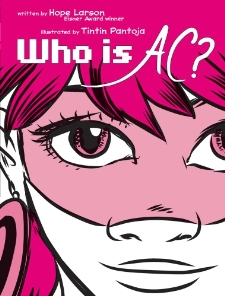
I love most of Hope Larson’s graphic novels, Gray Horses, Chiggers, Salamander Dream, Mercury, with the exception of her adaptation of A Wrinkle in Time. I was interested to see how I’d like the oddly titled Who is AC? which is written by Larson, whose art I really like, but illustrated by manga artist Tintin Pantoja.

Lin is moving to a new town with her family. She’s a writer who puts out her own ‘zine. On the plane she gets a mysterious phone call that somehow results in superpowers, and further shenanigans ensue in creating a villain. There are a handful of strong female characters.

There’s lots going on with a big cast of characters. Good and bad lurk in the cyber-background and while this is clearly the beginning of a series, it is a standalone story. While it worked better for me than Foiled and Curses Foiled Again, this feels more disposable than Larson’s earlier works.

The Movie Update

Saturday, May 4th, 2013

Oops. I’ve accidentally now watched more movies this year than I’ve read books, and have been reading a bunch of graphic novels, so it isn’t even like there are chunksters slowing me down. For a while I stopped requesting DVDs from the library because the queues were so long. Now I’m back in the habit. And a habit it is, in the negative sense of the word, when my husband has to warn me to stop using his account to reserve things or he’s going to change his password.

I can’t even blame recent binges or Blu rays from Half Price Books, since none of the recent viewings are from recent used purchases. Sigh. I suppose there are worse habits to have.

Django Unchained
(2012) Hyper violent, of course, it didn’t impress me as Inglourious Basterds did. Good, but overlong and unfocused. I do like the revisionist history/wishful thinking aspect that it shares with IB.

Pitch Perfect.(2012) Flawed, but charming, like a real person. Don’t have high expectations, and it’ll be fun. Geek note: I bought the soundtrack, plus Kelly Clarkson’s Greatest Hits after watching it.

Dredd (2012). This I borrowed from the library because I thought my husband would like it and I watched it too. Hyper violent, again, but with dark humor, and an intriguing villain.Like V for Vendetta, this comic-book adaptation made more sense when it was grounded in Thatcher’s England.

Clueless
(1995). I was reminded of it when I saw this article on game theory. Charming and fun, but a little low on the acting quotient. Paul Rudd has come a long way.

Iron Man 3.(2013) Date night. Glad I saw it before anything got spoiled, ’cause there’s loads of stuff to spoil. But overloud, overlong, and over ’splodey. Towards the end stuff was going down and I just kept thinking, “I’m bored. This is silly. Please move the plot along.” It does set things up interestingly for the future. But I’d say see it at a matinee, though sooner is better because of spoil-i-tude.

P.S. We saw a trailer for The Lone Ranger, that has Johnny Depp playing Tonto, and in Iron Man 3, Ben Kingsley plays a character called the Mandarin. Why are white people playing non-white roles, still? Shouldn’t we have moved past this? Can’t we PLEASE move past this, and have more non-white roles in movies played by non-white actors?