Author Archive

Why I Blog

Monday, February 21st, 2005

I started a blog in June of 2002 because I wanted to practice my writing and editing skills. Writing a public weblog ensured that I’d write, regularly. This regular writing has also helped me to get over writers block. Best of all, though, it’s helped me become a fairly fast writer and editor. I’m writing a teen novel, and am nearly through the fourth draft. Today, during a lovely long nap that my son Drake took, I was able to write another 2800 words, as well as edit the almost 4000 words I’d written over the previous two evenings.

At different points in time when I’ve had other things going on, I’ve thought that I should, and even tried to, take a break from blogging. It hasn’t worked. What I’ve found is that writing begets more writing. The more writing I do, the more writing I want to do, and the more writing I’m able to do.

For a long time in my life I fancied myself a writer, though I hardly wrote at all. Writing a weblog changed that. Now hardly a day goes by that I don’t write something, somewhere. Blogging gave me the structure for a writing practice, so I could stop just talking about being a writer, and actually get down to the messy business of writing itself.

50 Book Challenge, books 2 through 5

Monday, February 21st, 2005

2: Yolen, Jane, Briar Rose. New York: Tor, 1992. Extremely well-done fairy tale interwoven with Holocaust historical fiction that neatly avoids the usual cliches.

3: Thomas, Rob, Rats Saw God. New York: Simon Pulse, 1996. An insightful boy coming-of-age novel, including sex, by the creator of the television series Veronica Mars.

4: Vaughn, Brian K. (writer), Harris, Tony, (penciller), Feister, Tom (inker), Ex Machina Volume 1: The First Hundred Days. La Jolla, CA: Wildstorm Productions, 2005. Collection of the first five issues of new comic-book series about Mitchell Hundred, who acquires strange powers and goes on to become the mayor of New York City. Funny, intriguing, fabulous art.

5: Vaughn, Brian K. (writer), Guerra, Pia/Parlov, Goran (pencillers), Marzan, Jr., Jose (inker), Y the Last Man Volume 4: Safeword. New York: DC Comics, 2004. Latest collection of compelling comic book series about Yorick, the only male on the planet after a plague wipes out the rest.

I recommend them all.

50 Book Challenge for 2005

Sunday, February 20th, 2005

I am a recent convert to Blog of a Bookslut, which has links and notes to all sorts of literary goings-on by Michael Schaub and Jessa Crispin. At the beginning of the year, Crispin noted that there was a 50 book challenge for 2005:

“The idea, of course, is to read 50 books in 2005 and blog about them either in this livejournal community or on your own blog.

I thought, “What a great idea,” and have spent six weeks trying to get around to it. I’m doing the last six weeks retroactively. I’ll try to keep the reviews short; I’ll say it in a sentence, if I can.

1: Swordspoint, New York: Tor Books, 1989. A swordfighting fantasy in which men sleep with women and men, but there isn’t a word for it; it’s just what people do. Quick and fun, but not without literary merit.

Crossovers, not Young Adult

Thursday, February 17th, 2005

I attended the mid-winter conference for the Society of Children’s Book Writers and Illustrators last weekend and was privileged to hear two talks given by Michael Cart, an expert on young adult literature. Cart noted that the market once referred to as young adult was now dividing roughly into three age groups: 10 to 14 years, middle grade novels; 14 to 18 years, teen novels; and 18 to 25 years into a market he proposed referring to as “crossover”. He and many others have long decried “young adult” as derogatory; the books and the readers who are their audience are not somehow less than adult. These crossover books are sometimes books published as teen fiction but read by an older audience, or books marketed to an adult audience that are also read by teens. The marketing department of the publisher makes the call whether teen versus adult. Cart wondered why publishers in the U.S. couldn’t do as some have in England, putting books out in different formats for different markets.

Some books that were published as adult but that featured teen protagonists include The Lovely Bones by Alice Sebold, Life of Pi by Yann Martel, and Prep by Curtis Sittenfeld.

Francesca Lia Block, one of my favorite authors, was this year’s recipient of the Margaret A. Edwards award, which honors an author’s lifetime achievement for writing books that have been popular over a period of time. The Margaret A. Edwards Award is sponsored by School Library Journal and administered by the Young Adult Library Services Association (YALSA). Cart noted that Block was one of the first crossover novelists, whose teen novels were also read by adults.

A recent link from Blog of a Bookslut, though, points out other, less impressive and enlightening crossover books, including the Sisterhood of the Pants books, the Gossip Girl series and others. In a damning comparison, one of the authors hopes that her book will be as popular as Sweet Valley High and Goosebumps books were. For her sake, I hope her book has somewhat more literary merit.

Opting out of the Mommy Wars

Wednesday, February 16th, 2005

I was away for a week, but it’s still taken me some time to put together my own response to the 01/30/05 New York Times piece on mommy blogging, “Mommy (and Me) by David Hochman.

Many of the responses to Hochman’s piece have been angry and defensive. They see his piece as the latest attack in the mommy wars. I used to consider myself a mommy blogger; I even wrote here and here against those who would write against them. I didn’t find Hochman’s piece to be an attack on mommy blogs, though. There was critique, but I also found empathy, e.g.,

Daniel J. Siegel, a psychiatrist on the faculty of the Center for Culture, Brain and Development at the University of California, Los Angeles, and co-author of “Parenting From the Inside Out,” said that what is being expressed in these Web sites “is the deep, evolutionarily acquired desire to rise above invisibility, something parents experience all the time.” He explained, “You want to be seen not just by the baby whose diaper you’re changing, but by the world.”

and

But perhaps all the online venting and hand-wringing is actually helping the bloggers become better parents and better human beings. Perhaps what these diaries provide is “a way of establishing an alternate identity that makes parenting more palatable,” said Meredith W. Michaels, a philosophy professor at Smith College and the co-author of “The Mommy Myth: The Idealization of Motherhood and How It Has Undermined All Women.” “You’re turning your life into a story that helps answer the question, ‘Why on earth am I doing this?’ ”

Yet many of the responses to the piece, some written by the bloggers quoted in it, were unhappy with it, and disagreed with statements like

Today’s parents - older, more established and socialized to voicing their emotions - may be uniquely equipped to document their children’s’ lives, but what they seem most likely to complain and marvel about is their own. The baby blog in many cases is an online shrine to parental self-absorption.

I found that Hochman’s piece contained both empathy and criticism and I appreciated both. Yet the responses relayed mostly a perception of criticism:

Andrea Buchanan of Mother Shock grumbles here that her book but not her blog was named, and disagrees that parental blogging is anything “remarkable.”

Alice Bradley of Finslippy calls it “faintly damning” here.

Melissa Summers of Suburban Bliss says here that it’s “vaguely insulting.”

Ayelet Waldman of Bad-Mother gripes here that she was only quoted on the second page. Read down to a comment by “metacara” that is critical of Waldman’s comments in the article.

Heather Armstrong of Dooce notes here that

I had a hard time containing my glee � not because I and some of my fellow women writers were made out to be selfish, resentful, overreacting pigs in search of validation; funny that none of us were informed that the article would run with that notion when we were interviewed � but that my child�s green eyes were staring at me from the pages of a national paper.

T.O. Mama of MUBAR writes here what most other mommy bloggers say is the best and most balanced response to Hochman’s piece. She says “the article was not troubling itself but it raised some tricky issues.” Yet what’s interesting is the string of comments that follows her post, most of which criticise the NYT piece, and don’t acknowledge it as complicated.

Jen Weiner (pronounced WHY-ner, not WEEner, FYI) of Snarkspot clarifies, with her tongue firmly in cheek, here that her blog “isn’t just an ‘online shrine to parental self-absorbtion.’ It’s an online shrine to authorial self-absorbtion, too!”

I think Weiner’s comment is interesting, because she acknowledges on her blog, as she did in her quote in the NYT piece, that the parent blogs are self-involved. Her breezy tone, though, refuses to let this stick as a judgment. She goes a step further to say that her blog (a journal/diary type of blog) was self-involved before her daughter arrived, and has remained self-involved beyond her daughter since she became a mother. Weiner’s quote implies, correctly, I think, that many blogs are self-involved. And it’s that point that T.O. Mama took issue with from the NYT piece. Not that mommy blogs were being questioned, but that they were being questioned while other blogs weren’t; why are moms singled out for special attention and criticism?

Perhaps the most prevalent gripe about mommy blogs is that many are poorly written. True, but there are a lot of poorly written blogs out there, mommy or not. And while some are poorly written, others are both well written and funny.

So what’s the harm, then, if they’re well written and funny? They can be entertaining, and, as noted in Hochman’s article, they can also help struggling parents out of isolation.

One harm is noted by Hochman, who wonders about what the child in the future will think, “But the question is, at whose expense? How will the bloggee feel, say, 16 years from now, when her prom date Googles her entire existence?”

Hochman further quotes blogger Ayelet Waldman, “Fundamentally children resent being placed at the heart of their parents’ expression, and yet I still do it.”

Additionally, much of the content of mommy blogs is venting. Venting, in short spurts, can be a good thing. It releases pressure so that a system can function in equilibrium. But venting as a matter of everyday practice isn’t healthy, for either the ventor or the ventee. It devolves into bitching. Griping. A lowest common denominator of discourse.

The author of the weblog Mental Multivitamin noted the harm of such venting in an email she wrote in the wake of the NYT piece that she quotes here:

…if, in fact, weblogs are a historical record of the everyday (as the NYT suggests), [then] angst-soaked entries about the flu or potty training or whatever will be prevailing message of our time — not, for example, the pursuit of a rich interior life via reading, thinking, learning; that child- and spouse-bashing, however cleverly written, will represent the common experience of the ordinary mother, not celebration, wonder, merriment….

For more on parenting and mommy blogs by Mental Multivitamin, see her response to the Hochman article here. Interestingly, she also focused on the criticism rather than the empathy in his piece; unlike the other writers I’ve noted, she applauded his critique.

I have a further concern, though. Even if books and blogs contain both “angst-soaked entries” as well as “celebration, wonder and merriment”, then I believe that the former is what leaves a more lasting impression; I don’t believe a reader gets a balance of both. When writers detail the drudgery and the joy, the drudgery gets more print. It’s more concrete, it’s more physical, while the moments of joy and wonder are more fleeting and often emotional. The response to Hochman’s piece mirrored the difficult, if not impossible task, of creating a balanced portrayal that includes both difficulty and joy. His piece contained both, yet the negative got the most attention.

I wrote on one of my previous sites, Mama Duck, here, about how telling the truth about the difficulties had been a trend in recent motherhood books that I found myself unwittingly repeating in my mommy blog. I vowed to try harder. That was last June. Even with that awareness, I still feel like I failed to overcome the focus on the mundane that Mental Multivitamin decries.

In the 1950’s, we had a June Cleaver portrayal of motherhood as noble and tidy. Then there was the antithesis of telling it like it is, starting in the mid 1990’s, perhaps most notably with Ann Lamott’s memoir Operating Instructions. Now that antithesis is reaching a fever pitch with the mommy blogs. Again, we have a backlash, the unfair criticism that T.O. Mama questions. The backlash means that the antithesis of the truth-telling is no-better than the fog filters of yesteryear. I take this as a challenge to move toward a synthesis: something that celebrates the joys, tells the truth about the pain, but doesn’t dwell so much on the latter than the former is effaced.

Like many others, I was blogging before I became a mom. I blogged about pregnancy, birth and motherhood because I was so gobsmacked by the experiences. I felt unprepared and very alone. What the New York Times piece and what the multitude of responses to it have done, though, is to make it very clear that while I felt alone, I never was. There is an ever-growing number of books and blogs that proves that many women (and men) are surprised and frustrated by the challenges of parenthood. The point I have reached, then, is that there is no need to add my voice to the crowd. I no longer care to participate in the “motherhood is hard” discussion. This is not just true of writing, it’s also true of reading. What I write is inextricably tied to what I read. Reading and writing about the tough stuff just encourages me to focus on the difficulties, instead of keeping my eyes open for the moments of joy and surprise.

I became a parent because I wanted to learn. What I want to write about is that learning process, both in being a parent and in general. I will still write from personal experience, which includes motherhood. But I’m going to write in a way that emphasizes the learning and the joys. I’m not going to pretend that the tough stuff doesn’t exist. But I think I’m going to share that privately, rather than with all and sundry online.

Fashion for all women

Wednesday, February 16th, 2005

From Carolyn Mackler, The Earth, My Butt, and Other Big Round Things, (Massachusetts: Candlewick Press, 2003):

Strawberry is a funky discount store that I’ve browsed in before, but I’ve never had the guts to buy anything there. I like that they have cool clothes in every size, from extra-small to extra-large. And they’re all mixed together, so the fat girls aren’t banished to the fat floor where the dresses look like gunnysacks and the mannequins resemble embalmed grandmothers. (P. 187)

I just finished this book, and recommend it. It’s shelved at libraries and bookstores in teen fiction, formerly known as young adult–more on that distinction later, I promise. The main character, Virginia Shreves, has an emotional depth of character and a strong, funny voice.

I’ve written before about fashion injustice for non-mainstream sizes here, and here.

Lobsters, revisited

Tuesday, February 15th, 2005

I wrote recently here about an episode of America’s Test Kitchen in which they killed then cooked a lobster. I was surprised when the director of the show, Herb Sevush, took the time to write a detailed and thoughtful response, which I will reprint so it appears on the main page, and not hidden in the comments.

I�m glad to hear you are enjoying ATK. But if you�re upset about the lobster I�m pretty much the guy to blame.

You�d be amazed at how much time we spent discussing and debating the different ways of killing the lobsters. The way we showed you is much faster and more �humane� than boiling or freezing a lobster to death. The other problem is that we were pan broiling it and both pre-boiling or pre-freezing would have ruined the dish. We discussed starting with the lobster already cut up, but as you�re probably aware the ATK style is to show, in detail, how a dish should be prepared at home. The cutting of the lobster was too important to skip.

We know that some people are offended by the way it looks when we cut them up, especially the twitching that occurs well after they are dead. The problem is an even larger number of people like to eat lobster, and this being the most delicious lobster recipe I�ve ever tried, we wanted to present it.

So, with me leading the way, we just went for it. It�s my own opinion that eating something you’re too disgusted to watch being prepared is the height of hypocrisy. For those who don�t eat lobster and were turned off, what can I say other than we won�t do it again any time soon. Although we will break an egg from time to time.

I�m glad you liked the new science segments. We�ve been trying to come up with the right way to do science for years and then our producer discovered Odd-Todd. I think he�s a major talent.

Again, thanks for watching, and I hope the rest of this season�s offerings don�t cause you such difficulty.

Herb Sevush
Director

I was glad to learn that the method they depicted was in fact more humane than boiling (the method decried by David Foster Wallace in the Gourmet article I linked to in the original post). I was not actually surprised to learn that the staff had spent a lot of time discussing and debating both whether to show the recipe and how to do so. I have been reading Cook’s Illustrated for over ten years. I’m a huge fan of their thorough approach to food in general and recipes in particular. I took the online name of Girl Detective because I’m naturally curious, but when someone else does such a thorough job of investigating something that interests me (in this case, food), then I can trust in their work and spend my time cooking and eating, not experimenting.

I agree with Sevush’s point that it’s hypocrisy to eat something I refuse to see killed. My modern, non-agrarian life keep me insulated from the means of producing food. Sevush’s letter was a good reminder that I should put my food ethics where my squeamishness is, or get over it. I haven’t eaten lobster since seeing the episode and am not sure if I will again. If I do, though, I will now be fully cognizant of what happened on the way to my plate. And for that heightened consciousness, I thank both America’s Test Kitchen and Herb Sevush.

The brain is a muscle

Sunday, February 13th, 2005

It has been fascinating to see Drake develop as a reader over the less than 18 months he’s been alive. Over the past six months he has become more involved in reading all the time. If we hold out two books, he will imperiously push one away. Once we have finished reading a book, he will shut it, flip it over and return it to my hands, indicating that he wants to hear it all over again. When he’s done with however many times he wants to hear that book, he’ll slide off my lap, toddle to his shelf of the bookcase and return with another selection. His favorites shift and change. There are certain books that we haven’t read in months, and others that we suddenly see returning to the rotation. He has an extensive collection of board books, but over the last few months I’ve been supplementing those with paper picture books as well. When he first listens to a new book, especially a longer picture book, he doesn’t make it all the way through. He’ll bring the book over again and again throughout a day, and day after day. Over time (not even necessarily each time; it’s more gradual than that) he will listen to more words on each page, and listen to more pages out of the entire book. Yesterday he sat through more of Mike Mulligan and his Steam Shovel by Virginia Lee Burton than he ever yet had. Tonight he listened to nearly all of Bedtime for Francis by Russell Hoban, after which he insisted on two times through Come Along Daisy by Jane Simmons, followed by Goodnight, Moon by Margaret Wise Brown. We finished with Mike Mulligan, after which I spirited him into his bed before he could ask for another. It is clear that his mind is growing and stretching with each reading. It’s also clear that he wants this exercise; he brings the books to us again and again. While we have been guilty of occasionally “misplacing” certain books that we’d read past our point of tolerance, my husband and I almost always follow Drake’s lead, reading the books he wants as many times as he wants to hear them. Yes, occasionally it can be tedious. But really, truly, watching a person come into being as a reader? It is stunning.

Battlestar renewed

Friday, February 11th, 2005

Thanks to Blogenheimer for the news that Battlestar Galactica has been renewed by the Sci Fi channel for a second season. According to Sci Fi Wire, creator Ronald Moore wants the second season to address questions of religion.

A few years ago, I attended the annual conference of the American Academy of Religion. Dr. Ross Kraemer, currently a professor of Religious Studies at Brown University, chaired a session on Star Trek and religion. The purpose of the session was to determine whether there was sufficient interest and material for a scholarly investigation. The answer must have been yes, because she went on to co-author Religions of Star Trek with fellow religious scholars William Cassidy and Susan Schwartz. Unfortunately I remember little of the session, other than that it was quite crowded, and that Dr. Kraemer firmly but politely shut down an eager audience member who wanted to know her thoughts on religions in Babylon 5.

Point of trivia: did you know that one of the races portrayed in Babylon 5, the Gaim, was named for Neil Gaiman? They sported stylized gas masks like that of Morpheus in early issues of Gaiman’s Sandman.

Dr. Kraemer’s scholarly focus is usually women’s religion of the Greco-Roman world. She is perhaps best known for her work on the text known as “Joseph and Aseneth,” a piece thought to be included in the pseudoepigrapha. More on the story of Joseph and Aseneth can be found here, including reviews of Kraemer’s book When Aseneth Met Joseph.

Writers Block

Friday, February 11th, 2005

I’m experiencing a maddening form of writers block. I have plenty to write about, but I can’t shape it into a form that pleases me. I feel as if I’ve lost any small skill to write in a coherent, meaningful way. I know the way out of this rut. It’s to write, trying to keep things brief and focused. Even that simple-sounding prescription feels beyond me today, though.

The current blockage is ironic. I haven’t posted in over a week because I was out of town for a writers conference. The speakers and sessions sent a combined message of humility and hope: write, hone your skills, continue in spite of almost inevitable rejection, and someday you may be published.

Midway through the conference I experienced a whopping low. I was suddenly certain that I was a hack and that my manuscript was crap and not worth any further time or effort. Either of those might be true. But if I follow the advice to keep writing and learning, then someday they might not be true.

I hope to be a better writer, therefore I write. It’s very simple, really.

At last, the truth is revealed

Tuesday, February 1st, 2005

On last Friday’s (01/28/05) episode of Joan of Arcadia, Annie Potts finally proved what television viewers have always known.

She is evil.

Kudos to Joan of Arcadia for casting her so perfectly against type. The reveal was so satisfying it was positively delicious.

I’ve written before about why I like the show. It focuses on a family that includes teenagers. Amazingly, the portrayal feels both realistic and yet, *gasp*, not bitter or depressing. And every member of the family gets a thorough characterization.

More on Battlestar Galactica

Monday, January 31st, 2005

In my previous entry on the new Sci Fi Channel series of Battlestar Galactica, I noted that the show had “English roots”. My friend Blogenheimer asked me to clarify what I meant by this. Upon further reflection, I think it would be more accurate to note that the show has pronounced English influences. Technically, its roots are the original 1980’s era American television series.

First, the current series was developed and written by Ron Moore, a former Star Trek writer who is English. Second, the new series was partially financed by Sky One, “the UK’s most popular non-terrestrial entertainment TV channel.” The series initially ran on Sky One to strong reviews, and premiered in the US on the Sci Fi Channel in January 2005. I remark on the English influences because I think the show has a dark intelligence that is much more characteristic of English television than it is of most mainstream US television.

For example, in last Friday’s episode, “Act of Contrition,” Starbuck confessed to Adama that she had passed Zak (his son and her lover) for basic flight though he shouldn’t have qualified. Zak was subsequently killed in a flight accident. Edward James Olmos stood stony faced, inches from her as Starbuck stammered and sobbed. She finished, he made a comment about a related issue, and she began to babble, relieved to have come clean.

As I watched, I cringed as she began to speak again. “Run, run!” I urged her in my head.

“Get out,” snarled Adama, “while you still can.”

A lesser show would have played this scene differently. It would have had Adama forgive her, or at least show something less harrowing than the billowing, murderous rage that Olmos so skillfully projected without saying a word or moving a muscle.

I continue to be surprised that my new favorite show is science fiction. I worry for its success. Neither science fiction shows nor dark shows have a good record in the US. Yet spurred by HBO shows like The Sopranos, Sex and the City, and Six Feet Under, networks other than the big three (ABC, CBS and NBC) and the newer three (FOX, WB, and UPN) are building a strong and loyal viewership for new shows, providing both strong support and canny marketing. FX has done well both with Nip/Tuck and Rescue Me. I hope that Battlestar Galactica will continue to surprise and entertain, and in the process become the Sci Fi Channel’s biggest hit.

Slashdot teaser for the new Battlestar Galactica series
More on Battlestar Galactica at
TVTome
IMDB
NixFlix

Why I don’t buy toys for my child

Sunday, January 30th, 2005

That isn’t entirely true. Just last week I bought him two toys: a bouncy plastic ball for $2.49 and a baby doll. I couldn’t stomach buying the blond, blue-eyed girl doll, so instead I bought the non-white, potentially gender-neutral doll. (The doll came with a purple headband, which I threw in the trash.) The doll came with a toy bottle and a rattle. We handed the baby doll to Drake and he lunged for the bottle, then put it immediately to the baby’s mouth. We didn’t show him, I swear. Is it innate, or just painfully obvious?

But, back to the originally intended topic of this post. I try not to buy toys for Drake. Obviously, sometimes I do not succeed. He has friends and relatives that have been very kind to him, and he really seems fine with the toys that he has. Occasionally, I feel as if I should be buying him developmental toys, or fun toys, or arts and music toys. I fret that perhaps he isn’t learning because we don’t have what he needs.

And then, he starts to play with the empty mustard bottle. And won’t let it go. And wants to sleep with it. Later, he takes the mini-loaf pans out of the cupboard and stacks and unstacks them.

He will find what he needs, when he needs it. And it does not have to cost money and be colorful and have batteries.

But a mustard bottle?

Oh, for the love of Mike.

Wishful product buying

Friday, January 28th, 2005

I saw a blurb in the February issue of Lucky magazine about a product I just had to try: California Baby’s Overtired and Cranky Spritz. According to Lucky, it’s a perfect pick-me-up for both babies and grown ups during that dead zone in the afternoon between 3 and 5 p.m. I guiltily plunked down $12 because even the possibility of relief during the dead zone was too much to resist.

Verdict? Well, it doesn’t make me crankier. I think the phsyical shock of getting something cold and wet spritzed on the back of the neck might be what derails fatigue and crankiness as much as the fragrance itself. It may not be so much a calming thing as a distracting counter-irritant. Is it worth $12? Probably not.

Music meme

Friday, January 28th, 2005

I’ve been tagged by Duff at GirlReaction. She and I seem to have synchronous tastes in music and books, so we raid each others’ blogs for ideas. I’m lately feeling woefully out of touch, though not as much as my husband G. Grod, who demanded to know who the hell Bright Eyes was when I brought home his CDs earier this week after FINALLY finding them at Target.

1. Total amount of music files on your computer:
Uh, no idea. I rarely listen to music on the computer. I’m a luddite that way.

2. The last CD you bought was:
I bought three: the two new Bright Eyes I’m Wide Awake, It’s Morning and Digital Ash in a Digital Urn and the new Ani DiFranco, Knuckle Down. I’m hoping I can find a clear melody or bass line on this latest Ani album; her last couple albums have a lot of free-form lyrics–they haven’t enthralled me.

3. What is the song you last listened to before reading this message?
“Are You Lonely Tonight” by Elvis, on the new MPR station 89.3 The Current, which I feel guilty about loving, since it came into being when MPR gobbled up the little St. Olaf classical station.

4. Write down 5 songs you often listen to or that mean a lot to you:
“Snuggle Puppy” by Boynton/Ford from Philadelphia Chickens (a panacea for our son Drake)
“Closer to Fine”, Indigo Girls (a panacea for me)
“Solsbury Hill”, Peter Gabriel (see above)
“Have a Little Faith in Me”, John Hiatt (the first song at G. Grod’s and my wedding; reminds me to be nicer to him. I need frequent reminders. I can be rather grouchy.)
“The Immigrant Song”, Led Zeppelin, because I’m trying to teach Drake to sing the opening. So far he’s got the first two notes, out of four.

5. Who are you going to pass this stick to (3 persons) and why?

M. Giant at Velcrometer, because he’s funny.
Blogenheimer, because he’s the reason we own all our Firewater CDs.
Becca, because her iPod got stolen and perhaps this will send good musical juju her way.

And I don’t know if it counts since he’ll probably post here, but also my husband G. Grod, because I don’t know what he’ll answer.

What not to see

Thursday, January 27th, 2005

Here’s why the movie Constantine is going to suck.

1. Movies based on comics almost always suck. Recent notable exception: Spider Man 2. It helps if it’s made by a fanboy.

2. Keanu is seriously miscast for several reasons. The character of John Constantine is smart, blond, and English. He’s also in his early forties. Keanu is too young, stupid, American and brunette to play this part. Keanu only works in movies where he’s playing a NVB (not very bright) character: Bill & Ted’s Excellent Adventure, Speed, the Matrices. You know who would’ve been great as Constantine, though now he’s perhaps a bit long in the tooth? Sting.

If the premise of Constantine sounds interesting to you then get to your nearest comic shop and pick up a copy of the GN (graphic novel) Hellblazer: Original Sins, by Jamie Delano et al. If you like it, then pick up some of the other Hellblazer GNs by Garth Ennis. Various authors have done awful things to the Constantine character over the years (as in the current Books of Magic series, which aggravates me) but these early collections are quite good.

One more luxurious thing

Wednesday, January 26th, 2005

I forgot one thing I did while I had my getaway last weekend, and it was to browse in a well-stocked book and music store. I went book by book through the young adult section and then traipsed around the whole store looking up books that had been on my list for a while and seeing if they had them (almost without exception, yes) and if they looked cool enough to stay on my list (also mostly yes.) I had time both before and after the movie to do this. It was so much fun to browse with no time limit, with no one waiting for me. I managed not to buy any books, but I was persuaded to buy two CDs from my list, since one was on sale and the other was relatively inexpensive, and I played them both once I got to my hotel room: Tift Merritt, Tambourine and Neko Case, The Tigers Have Spoken. So far, I’m pleased with both purchases.

A Room of My Own

Tuesday, January 25th, 2005

My Chrismas gift from my thoughtful husband was an overnight at a nearby hotel. I left during Drake’s nap on Friday and returned 24 hours later. The short trip couldn’t completely reverse the upheaving effects of a tough week that was short on sleep, but it certainly helped, and was a lovely little interlude before jumping back into the fray.

I had a plan before I left, and it was to focus on things that are tough/impossible to do with Drake around. I took a lot of reading material, then picked out a movie to see and a closeby restaurant for dinner.

I saw In Good Company, a quiet little flick that was balm for my ruffled soul. It wasn’t high art, but it was charming, and smart in a subtle way. The ending didn’t feel surprising, but looking back on the movie, I thought it was easy to chart more predictable paths for it that would have left me at the end saying, “That’s stupid,” or “That’s obvious.” The movie adroitly sidestepped several trite possibilities and instead ended on a note that felt sweet and satisfying. I felt somewhat restored after the movie, as I did when I heard the uplifting notes of Peter Gabriel’s “Solsbury Hill” on its soundtrack.

At dinner, then breakfast the next morning, I was deliberate in my choices of what to eat and my pace in eating. I also did not read or do anything else but eat. It was truly a luxury to eat what I wanted and at my own speed, which is slow.

I revelled similarly in the luxury of having several hours in which to read. I brought a novel, a collection of short stories and essays, several comic books and a couple graphic novels. I felt like I had the literary equivalent of tapas. Continuing this multiplicitous reading has left me a bit at odds, as I wrote about yesterday, but for a short period of time it was quite heady.

I had hoped for a stupendous greeting from Drake upon my return, but it was not to be. He woke from his nap, as he often does, in good spirits but raring to get back on the ground and get moving. I’m not sure he even noticed that I’d been gone.

One thing marred the overnight. Even in a very quiet hotel, I had trouble sleeping. The last time I went away, I also was not able to sleep, so this time I’d taken the precaution of taking a sleeping pill. Alas, even on drugs, no dice. I think that the last 17 months of oft-interrupted sleep have permanently damaged my ability to sleep deeply. Even with restless sleep, though, I still returned home in better, calmer spirits.

It makes me crazy

Monday, January 24th, 2005

Or, as my husband G. Grod would be quick to note, crazier than usual. I’m reading multiple books right now, and I’m having a hard time of it. I can’t tell if I’m feeling fuzzy and fragmented as an effect of being in the midst of multiple readings, or if I’ve broken my usual hard and fast rule against multiple books because I’ve been feeling out of focus.

No matter. Either way, as cause or effect, I am not an advocate of being in the midst of multiple books. I hate multi-tasking. Thus it is good that I no longer have a corporate job, and bad that I’m a mom because it’s very, very hard to just do one thing at a time while caring for my toddler, Drake.

I formed my hard and fast rule some time ago, when I realized that reading more than one book at a time just made each one harder to follow, and slower to finish. So it’s been one book at a time for some time now.

I’m gearing up for a writers conference, though, and I’m also trying to put some finishing edits on novel #1. So I put the novel I was reading–Tam Lin by Pamela Dean–aside so I could read something more relevant to the tasks at hand. I then picked up The Best American Non-Required Reading 2002, edited by Michael Cart and Dave Eggers. I also started on the articles from the most recent edition of the Children’s Writers and Illustrators Market. In the midst of these I’ve been reading a lot of different comics (Fables, Books of Magic, 100 Bullets, Gotham Central, Y the Last Man, Ex Machina, Girl Genius, Planetary….) My head is spinning with fact and fiction, and I’m wondering about the easiest way to get off this merry-go-round yet still do the reading I need to do.

It’s probably not reading more comics. But I think that’s what I’m going to do anyway. Perhaps it’s my subsconscious telling me I’m not getting my daily recommended allowance of fiction by reading the Cart/Eggers collection and the Writer’s Market. See what happens when I don’t get fiction? It’s not pretty.

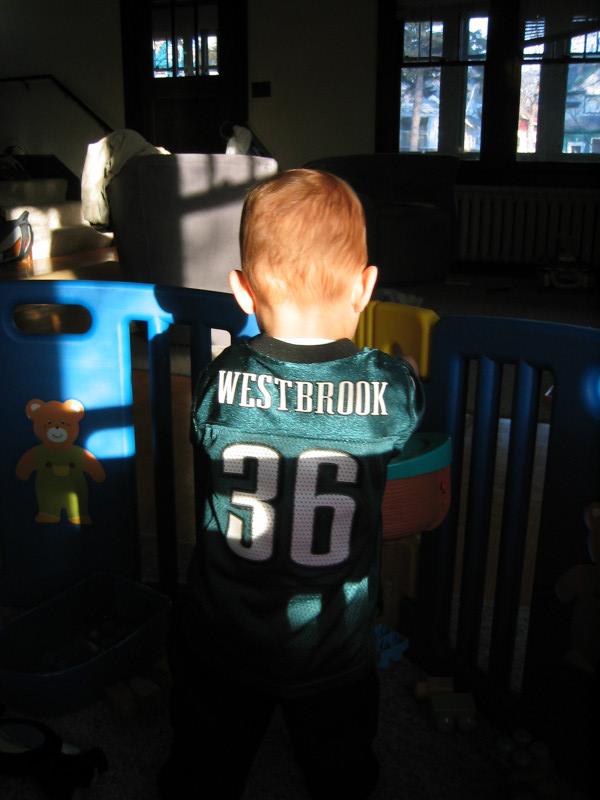
Yay, Eagles; Go Eagles!

Monday, January 24th, 2005

Westbrook

My husband is the football fan in our house, not me. Yet even I got sucked into the playoff frenzy of the past weeks, and spent a good chunk of the past two Sundays watching football. I was sorry to see first Indianapolis and then Pittsburgh fall to the Patriots, but beyond thrilled that the Eagles finally won the NFC championship, after losing honorably three years ago and choking the past two years. I thought it was fun to watch the Patriots in ‘01, when they were an underdog team and seemed to have god-touched good fortune as they went all the way. I’m not sure the Patriots can be stopped, but I hope the birds can give them a worthy challenge at the Super Bowl.