Author Archive

“Pattern Recognition” by William Gibson

Thursday, January 13th, 2011

I have something to admit. At the risk of losing my geek-girl cred, I had not read anything by William Gibson. Not even Neuromancer. Like many other books and movies, I’d always wanted to read it, but hadn’t yet managed to. Gibson’s Pattern Recognition started waving at me last year, when John Warner at the Morning News did a Biblioracle session; he asked readers for the last 5 books they’d read and recommended one to read next. He picked Pattern Recognition for me. Between one thing and another, I didn’t get around to it. A little later I noticed Pattern Recognition again on a friend’s Facebook page; she listed it as one of her favorite books. Third (and finally) my husband started the new William Gibson, Zero History, and felt he needed to return to Pattern Recognition, the first of the trilogy. As he re-read Pattern Recognition, then Spook Country, then Zero History, he kept telling me he thought I’d like them and if I read them we could discuss them. So, here I am, finally having read Gibson and Pattern Recognition. And I’m very glad I did.

Cayce (pronounced Case) Pollard is an advertising savant, hired for big bucks by global companies to evaluate logos and other marketing stuff. She’s also a “footage-head,” a devotee of found video clips from the internet by an anonymous creator. She’s doing work for the improbably named Belgian, Hubertus Bigend, when her worlds start to collide in intriguing and dangerous ways.

“The heart is a muscle,” Bigend corrects. “You ‘know’ in your limbic brain. The seat of instinct. The mammalian brain. Deeper, wider, beyond logic. That is where advertising works, not in the upstart cortex. What we think of as ‘mind’ is only a sort of jumped-up gland, piggybacking on the reptilian brainstem and the older, mammalian mind, but our culture tricks us into recognizing it as all of consciousness. The mammalian spreads continent-wide beneath it, mute and muscular, attending to its ancient agenda. And makes us buy things.” (69)

Gibson is shelved in sci-fi/fantasy, and while this book has elements of both, it’s much more complex than that. It’s also a mystery, with some philosophy, post-modernism and who knows what else thrown in. As I read, I was reminded of, among others, David Foster Wallace’s Infinite Jest, Pynchon’s Crying of Lot 49, Jasper Fforde’s Eyre Affair, and Stieg Larsson’s Millennium trilogy. I felt my brain twisting and turning as I read, firing synapses usually dormant. I very much look forward to Spook Country.
“The September Issue” (2009)

Tuesday, January 11th, 2011

If you, like me, are a magazine junkie, then watching the documentary The September Issue, is a mesmerizing romp. If you don’t care about fashion or don’t like reality TV, this isn’t likely to be your cuppa.

The film documents the production of the September 2007 issue of Vogue, the biggest in its history, and the one before the recession hit and paper prices went up. The putative heroine is Grace Coddington, the creative director, who clashes with Anna Wintour, the chilly, powerful editrix. The power dynamics are fascinating, as is the messy process of putting together the magazine that looks so pretty and shiny on the shelf in the fall. Coddington is funny and charming. Wintour is a piece of work. It’s interesting to see the real-life woman who inspired the character from The Devil Wears Prada.

“Megamind” (2010)

Tuesday, January 11th, 2011

I don’t know how the weather is where you are, but here in Minnesota, it’s pretty cold. Inexpensive, kid-friendly indoor activities are critical to surviving winter, so this weekend I took 4yo Guppy and 7yo Drake to see a bargain matinee of Megamind. Total for tickets and 2 popcorns: $11.50. Bonus, we went to the Riverview, so a great theater and real butter on what may be the best popcorn in town.

I enjoyed the movie a lot. Will Ferrell voices a blue guy super villain who has some troubles when things start going his way. Tina Fey is his love interest, Brad Pitt is his nemesis, and Jonah Hill plays the overweight schlubby guy. David Cross as Megamind’s Minion, a fish in a robotic gorilla suit, is really funny, as is the movie, which had me wondering what would happen once the set up was finished. I particularly enjoyed the use of ELO’s “Mr. Blue Sky” and the wink that Fey’s character, Roxanne, has a doorman named Carlton. Alas, Drake and Guppy were not as entertained as I was, and insisted on going to the lobby to the drinking fountain in the final scenes, then later declaring they hated the movie. Drake wouldn’t elaborate, but this usually means something scared him or creeped him out, then Guppy echoes Drake’s review and voila, we’ve got hate.

Movies are like food; I never know when the kids are going to like, love or loathe something. But I try to enjoy it when things go well, and not to go ballistic when they don’t. But I enjoyed the movie. And the popcorn.

“Cakewalk” Chocolate Chip Cookies

Monday, January 10th, 2011

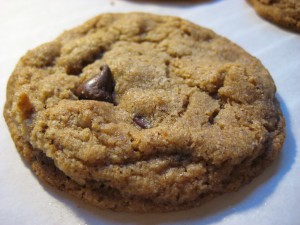
Chocolate Chip Cookie

The Cakewalk Cookie

I recently read Kate Moses’ memoir Cakewalk, which I borrowed from the library based on the statement at the blog Tipsy Baker that the recipe in them for chocolate chip cookies was perhaps unbeatable. My previous go-to chocolate chip cookie recipe was Pam Anderson’s, which I included with my previous Cakewalk entry, since I no longer had a copy of Cakewalk at hand and couldn’t share that recipe. Then I went out and bought my own copy.

As with everything in Cakewalk, memories of growing up are intertwined with memories of baked goods and recipes. The chocolate chip cookies were a survival mechanism:

In the solitary refuge of our kitchen, I gradually gained the confidence in my basic skill as a baker to start improvising, playing with proportions and ingredients until what I made tasted the way I imagined it could.

The chocolate chip cookies I bake these days only remotely resemble the cookies I baked when I was in junior high and high school. Still, when I make them, I sometimes think about those weirdo kids from junior high, friends for as long as we needed each other, learning to appreciate what good came to us–or not (189)

I’ve halved Kate’s recipe, since hers produces 4 to 5 dozen cookies, and put a strain on the engine of my Kitchenaid mixer. (I have the smaller, non-lifty-bowl kind). Two or so dozen of these will be plenty. Also, I use the method from Pam Anderson’s recipe, which produces a puffier cookie than the time I made Kate’s recipe right out of the bowl, though she says its best to refrigerate them overnight or up to two days.

Absolutely Best Chocolate Chip Cookies, adapted from Kate Moses’ Cakewalk
(makes 2 dozen cookie, more or less depending on size)

4/3 cup unbleached all-purpose flour
2/3 cup whole wheat pastry flour
1 teaspoon baking soda
1/2 teaspoon baking powder
1/4 teaspoon salt
1 1/2 teaspoons instant espresso powder
3/4 cup salted butter, at room temperature
1/2 cup granulated sugar
3/4 cup firmly packed light brown sugar
1 1/2 teaspoons vanilla
1 large egg, room temperature
3/4 pound high-quality chocolate, coarsely chopped (this is an a$$load of chocolate, and if you buy the good stuff, 3/4 pound will cost a lot. I used the Guittard semi-sweet chips my grocery carries in bulk. They were delicious, if not as rustic as chopped chocolate.)
Optional: 1 cup walnuts, toasted, cooled then chopped coarsely

In medium bowl, stir together flours, soda, powder, salt and espresso powder. Set aside.

In large bowl of electric mixer, beat the butter on medium speed for a couple of minutes, then add the sugars, beating until very light, about 5 minutes. Add the vanilla and the egg and beat again until very light and fluffy. With only minimal strokes of the mixer blade or by hand, stir in the flour mixture in three or four parts, mixing just until it disappears. Stir in the chopped chocolate and nuts, if using. The cookie dough can be used immediately, but it is better if chilled, covered, at least overnight or up to 2 days.

(If you refrigerate, I recommend scooping the dough into balls before doing so; scooping refrigerated dough is hard work and likely to bend a spoon or break an ice-cream scoop.)

Moses’ baking instructions: Preheat the oven to 350. On an ungreased cookie sheet, place balls of dough the size of golf balls at least 2 inches apart. Bake for 10 to 13 minutes, checking after 10 minutes, until the edges are light brown and the surface is crackly and set but the centers are still soft. Let cool for about 5 minutes on the cookie sheet, then transfer to a wife rack to finish cooling completely.

My baking instructions: After mixing the dough, place a sheet of parchment paper on a cookie sheet. Scoop dough either by rounded tablespoonfuls, or with an ice cream scoop, onto sheet. They can touch. Place cookie sheet with dough balls in freezer. Preheat your oven to 400. Cover a second cookie sheet with parchment paper. After 30 minutes, remove the dough balls, put 6 to 8 on each sheet, leaving at least 2 inches between them. Return the rest of the dough balls to the freezer. (You can make them after the first batch is finished baking, or cover them and bake them later.) Place dough in 400 oven and bake about 8 minutes, or until dough ball loses shape and collapses. Reduce oven temperature to 350. Open oven, switch cookie sheets top to bottom and front to back. Bake for 6 to 8 minutes more until cookies are light brown at edges. Remove from oven. Cool 5 minutes on sheets, then completely on wire racks. If you are baking more batches, return oven to 400.

“Stop When You are Going Good”

Monday, January 10th, 2011

Scott Gavin has a great excerpt from an interview with Roald Dahl in which he talks about his writing process:

But if you stop when you are going good, as Hemingway said…then you know what you are going to say next. You make yourself stop, put your pencil down and everything, and you walk away. And you can’t wait to get back because you know what you want to say next and that’s lovely and you have to try and do that. Every time, every day all the way through the year. If you stop when you are stuck, the you are in trouble!

I found it synchronous with my own thoughts on both writing and being online, and my attempt to limit bouts to 20 minutes. If I stop at 20 minutes, rather than trying to finish up, I don’t end up going to a next thing, and a next thing, and looking up and hours have passed without doing much at all.

Having the confidence to “stop when you are going good”, coupled with the ability to crank it up again the next day, feels like a more mature place to be in terms of one’s personal creative process.

Yep.

“Reducing One’s Virtual Itinerary”

Thursday, January 6th, 2011

My friend M, who blogs at Mental Multivitamin, has been a resource and inspiration in my own quest to make (and take) time for things like reading, writing and balance. In her latest post on making time, she gave new emphasis to something she’s suggested before:


Ruthlessly trim your virtual itinerary.

In other words, enough with the boards, the endless email checking, the social networking tools, the blogs, and the like. Visit sites that provide you with information, insight, and/or inspiration. And then? Get off the computer and…

Read. Think. Learn.

I’ve long struggled with an overlong virtual itinerary. For a long time I read too many blogs, and had too many on my list of Google feeds. (Yes, those TED videos are awesome, but having them pile up in my feed list was discouraging and unhelpful.) Even when I weeded those, I’d keep checking email, because apparently every new email sends a little jolt of pleasure to my brain. Then Facebook came along, and I could read what other friends were doing and comment back and forth. Also, I could play Scrabble with my sister, which was a nice way to keep in touch as we live far apart. I signed up for Good Reads. I’m spending lots of time in front of my screen, but little of that doing the writing I must do on the computer.

It’s past time to trim my virtual itinerary, but I know myself well enough not to make vague, sweeping declarations of intent. I know my attempt will be one of trial and error, progression and regression, as was this mother’s in “I took my kids offline.” in The Guardian.

Here’s my current experiment. I have a timer on my watch set for 20 minutes. I try to remember to start it when I get online. Failing that (which is not infrequent) I start it when I remember. When it goes off, I save my work, hibernate my machine, and go do something else: switch out the laundry. Make lunch. Do a few yoga poses. Read a chapter in my book. I tried this yesterday and today, and have been much more productive, while still finding time to blog, read feeds, and email. I think this could be a way toward balance and away from wanking about if I can make it a habit.

Fables v. 14: Witches by Bill Willingham et al

Wednesday, January 5th, 2011

I’ve cut back considerably on my comic reading in recent years, being diligent about only reading things that I like, and stopping on books and series that are less than great. I’m happy to say I tore through Fables volume 14: Witches. Powerful villains terrorize two factions of Fables, who fight back with surprising results. I was gnashing my teeth at the cliffhanger that ended #91, and the following two issues, while good, became an annoying distraction as I’m more interested in the main tale, specifically with Frau Totenkinder, who has always been one of my favorite characters, and who plays a central role in this volume.

Fables
the series posits a world in which characters from myth and fable live secretly in our world. It’s dark, magical, sometimes funny, and almost always engaging. For fans of dark fantasy, and other Vertigo titles like Sandman.

“Drinking at the Movies” by Julia Wertz

Tuesday, January 4th, 2011

A friend recommended the graphic novels Jonathan Ames’ The Alcoholic and Julia Wertz’s Drinking at the Movies to me at the same time, and they make good companions for each other. I wrote about The Alcoholic already. It’s dark and moody, while Drinking at the Movies is more upbeat and consistently funny. Wertz chronicles her move from SF to NYC with an eye at least as honest about herself as she is about others (as all good memoirists should be, I think).

This isn’t the typical redemptive coming of age tale of a young woman and her glorious triumph over tragedy or any such nonsense. It’s simply a hilarious–occasionally poignant–book filled with interesting art, absurd humor and plenty of amusing self deprecation.

She makes 20-something slackerhood funny, and her Sunday-comics boxy layouts and iconic art make this easy to read, even when the subject matter is serious, like her drinking, depression, addict brother, and more. Way more fun than it should be, which says a lot about the talent of its creator.

The Alcoholic came out in 2009. Drinking at the Movies was published in 2010. I just read “Lush for Life” at Salon today (link from The Morning News). There’s a weird synchronicity going on with tales of booze and debauchery.

“Die Hard” (1988)

Monday, January 3rd, 2011

And with Die Hard, our holiday movie-watching season came to an end. In case you don’t remember, Die Hard is set at the holiday party of Bruce Willis’ character, John McClane’s estranged wife. Bad guys led by Alan Rickman in his feature film debut crash the party, and mayhem ensues. In between clever one-liners, Willis gets beat up as he tries to save the day. This was a lot of fun to watch again. The attention to detail is impressive, and the plot hums along nicely. Willis is an entertaining smartass, but Rickman is fabulous as the villain. Well worth revisiting.

“The Alcoholic” by Jonathan Ames

Monday, January 3rd, 2011

Though published as fiction, the graphic “novel” The Alcoholic by Jonathan Ames reads more like real life. Whatever its blend might be, it’s an engaging, brutal, funny, tragic story.

My name is Jonathan A. and I’m an alcoholic. I have a lot of problems. Not more than the average person, really, but I have a propensity for getting into trouble, especially when I’ve been drinking. This one night, I came out of a blackout and I was with this old, exceedingly tiny lady in a station wagon.

Illustrated in moody black and white by Dean Haspiel, the tale charms and horrifies by turns. But because of its honesty, it’s never less than enthralling, even when Jonathan is at his most pathetic. For fans of other messed-up memoir authors, like David Sedaris and Alison Bechdel.

2010: My Year in Movies

Monday, January 3rd, 2011

In 2009, I consumed more movies (90) than I did books (66). I didn’t like that ratio. Yes, a movie can be consumed in 2 hours, while most books take longer, e.g. Infinite Jest, which I read that summer. Still, I love books more than movies; I hoped I could reallocate my time and turn the emphasis around. At the end of 2010, I’d seen 68 movies and read 91 books. I almost exactly inverted the ratio!

In addition to cutting back on movies, I also cut back on television. I gave up Project Runway and Top Chef, gave up on House, Glee, The Office and How I Met Your Mother. I didn’t watch one new show this fall. The shows I did watch were all 30 minute comedies, ones that consistently made me laugh: Modern Family, Community and 30 Rock. I look forward to the return of Parks and Recreation.

By whittling away the time I spent chasing movies with good reviews and tv shows I used to like, I enjoyed what I saw more, plus had more time, which I used to read and write. Here were the movies I feel earned their time last year.

Made me laugh: Philadelphia Story, Fantastic Mr. Fox, It’s Complicated, Hot Tub Time Machine, The Awful Truth, Scott Pilgrim vs. the World, Fletch

Made me cry (in a good way): Up, Toy Story 3

Entertaining: Jaws, Serenity, True Grit (1969), The Holiday

These entertained AND made me think: The Hurt Locker, Inglourious Basterds, Moon, Inception, The King’s Speech

Family movies liked by both kids and adults: How to Train Your Dragon, Porco Rosso, Castle in the Sky, Mary Poppins

Favorite holiday movies: The Shop Around the Corner, Trading Places and Die Hard

2010: The Book Covers

Sunday, January 2nd, 2011

I hope this doesn’t crash your browser. Or mine, for that matter.

2010: My Year in Books

Sunday, January 2nd, 2011

Best book of 2010 that I read in 2010: A Visit from the Goon Squad by Jennifer Egan. A tangled web of characters and events. I was engaged and enthralled.

Second best book of 2010 that I read in 2010: The Imperfectionists by Tom Rachmann. Similar to Goon Squad, but not as ambitious. Disclosure: other than comic books, these were the only two books from 2010 that I read in 2010. But both were excellent!

So nice I read them twice in the same year: History of Love by Nicole Krauss and Await Your Reply by Dan Chaon

Thumping good trilogies with strong female heroines with significant things that bugged me: Stieg Larsson’s Millenium and Suzanne Collins’ Hunger Games trilogies.

Good stuff: The Road by Cormac McCarthy; Lowboy by John Wray (not perfect, but I liked the Hamlet/Raskolnikov parallels); Ender’s Game by Orson Scott Card; City of Thieves by David Benioff; Big Machine by Victor LaValle; The Anthologist by Nicholson Baker; Anne Frank: the Book, the Life, the Afterlife by Francine Prose; Man in the Wooden Hat by Jane Gardam; Zeitoun by Dave Eggers; The Magicians by Lev Grossman; Cakewalk by Kate Moses

Made me laugh: The Catnappers by P. G. Wodehouse; This is Where I Leave You by Jonathan Tropper; Scott Pilgrim v. 1 to 6 by Bryan Lee O’Malley.

Others loved them; I did not: Let the Great World Spin by Colum McCann; The Help by Kathryn Stockett; A Gate at the Stairs by Lorrie Moore; Wolf Hall by Hilary Mantel; Little Bee by Chris Cleave

I got hooked on these classics: Madame Bovary by Gustave Flaubert, trans. Lydia Davis; Villette by Charlotte Bronte; Far from the Madding Crowd by Thomas Hardy

I discovered The Suck Fairy had got into: Anne McCaffrey’s Dragonflight.

Related reading: After the Hunger Games trilogy and Tamara Drewe by Posy Simmonds, I read Hardy’s Far from the Madding Crowd, which the latter two pay homage to. After Madame Bovary, I read Flaubert’s Parrot by Julian Barnes and Gemma Bovery by the aforementioned Posy Simmonds. After Francine Prose’s book, I read Anne Frank, The Diary of a Young Girl, Definitive Edition. After Zeitoun I read the graphic memoir A.D. New Orleans: After the Deluge by Josh Neufeld.

Comic books: I read a lot of unremarkable graphic novels in 2010. Fortunately, I read a lot of very good ones, too: Unwritten by Mike Carey; Incognito and Criminal by Ed Brubaker/Sean Phillips; Parker: the Hunter and the Outfit by Darwyn Cooke; Scott Pilgrim volumes 1 to 6 by Bryan Lee O’Malley; Far Arden by Kevin Cannon

And a few remarkable ones: Stitches by David Small; Asterios Polyp by David Mazzuchelli; Tamara Drewe and Gemma Bovery by Posy Simmonds

I read a bunch of books that had been sitting on my shelf for a long time: Little Boy Lost by Marganita Lasky; Canticle for Leibowitz by Walter M. Miller, Jr.; Eats Shoots and Leaves by Lynne Truss; The Chocolate War by Robert Cormier; Desperate Characters and Borrowed Finery by Paula Fox; The Catnappers by P.G. Wodehouse; Quicksilver, The Confusion and The System of the World by Neal Stephenson; Villette by Charlotte Bronte; and Flaubert’s Parrot by Julian Barnes.

I did two reading projects: 15 books in 15 days, and Baroque Summer. Only my husband was brave enough to join me for the latter, but I had a great time reading Neal Stephenson’s Quicksilver, The Confusion, and System of the World with him.

Just couldn’t bring myself to link each book. Individual links can be found under 2010 books in categories on the right. Happy reading, readers!

Last Movies of the Year

Saturday, January 1st, 2011

Trying to wrap things up here with the last movies we watched in 2010:

Fletch
. Because there was a long article about it in Entertainment Weekly a while ago, and I never saw it enough times to know it well. Hilarious, worth re-watching, but the painful 80’s music is even worse than the “fashion” and big hair.

The Holiday
. A friend assured me I’d like it. Throughout the utterly formulaic beginning, I doubted her. But once Kate Winslet and Cameron Diaz switch houses, things became charming. Winslet and Jude Law deserve most of the credit, I think. Light and enjoyable holiday movie.

The King’s Speech
. My first movie in a theater since September! I went with friends Mr. and Mrs. Blogenheimer. Loved it. Firth is terrific, as is Bonham-Carter. It took me a while to recognize the woman playing Geoffrey Rush’ wife; it’s Jennifer Ehle, Lizzie Bennet to Firth’s Darcy. Weird to see them in the same film. Firth in a kilt? Woo!

Trading Places
. Another great holiday movie. It’s been too long since I’d watched it. Dan Ackroyd’s uppitiness. Eddie Murphy’s laugh. Wait for the crop report, and watch out for those frozen concentrated orange juice futures. I STILL do not understand the ending, even after I watched a dvd extra that purported to explain it.

Four Graphic Novels

Saturday, January 1st, 2011

I’ll try to briefly wrap up last year’s reading.

Anne Frank: The Anne Frank House Authorized Graphic Biography
by Sid Jacobson and Ernie Colon. How could a version of Anne’s story not move me? I was dry eyed at the end of this “graphic biography” with stiff, photo-based art and few new additions to the story, while condensing the rest to a bare personal and historical summary. This might be a good way to introduce a young reader to Anne’s story if they were daunted by her diary, but it is a poor substitute for that great book. I feel like a complete crank for not liking this book, but please seek out Anne’s diary or Francine Prose’s book on it instead.

Richard Stark’s Parker Book Two: The Outfit
by Darwyn Cooke. The shades of black and blue suit the noir tale perfectly. Cooke’s second adapation of Stark’s Parker books is a well-told and illustrated tale. Parker is a definite anti-hero, and though his and the other characters’ attitudes to women are abominably of their time and genre, it’s hard not to root for him. Also, this book is printed on heavy paper, with thick end pages of a mod design. It’s a lovely object.

Ex Machina volumes 9 and 10: Ring out the Old and Term Limits, by Bryan K. Vaughan and Tony Harris. I’ve felt ambivalent about this series for a while, and hoped that the creators could bring it to a satisfying close. They brought it to a close, but one that left me in a bad mood. The series is about Mitchell Hundred, a reluctant superhero who saved many on 9/11, and was subsequently elected mayor. The last two volumes of the series find him deciding not to run again, and attempting to finish out his term while also battling the friends and enemies working against him since the start of the series.

Some questions I had were unanswered, they made a long-suffering character suffer too much, in my opinion, and the meaning of the ending seemed too simple, and not even fitting for the series. Bah. These bridged the end of the year and the new beginning, and I hope 2011 will bring more auspicious reading. If you want a good series that ends with integrity, I highly recommend Neil Gaiman’s Sandman.

“Flaubert’s Parrot” by Julian Barnes

Friday, December 31st, 2010

A friend of mine from my book group of beloved memory (Philly, mid 90’s) said Julian Barnes was one of her favorite authors. So in 1999 I bought copies of Flaubert’s Parrot and A History of the World in 10 1/2 Chapters; they’ve moved with me twice and I still hadn’t read them. But I dusted off (literally) Flaubert’s Parrot after I read Lydia Davis’ new translation of Madame Bovary this fall.

Books are where things are explained to you; life is where things aren’t. I’m not surprised some people prefer books. Books make sense of life. The only problem is that the lives they make sense of are other people’s lives, never your own. (168)

Barnes’ book is narrated by Geoffrey Braithwaite, a retired physician and amateur but obsessive Flaubert scholar. He discovers a puzzle no one else has: which parrot did Flaubert refer to in one of his books? The book follows his meandering thoughts as he moves in and out of Flaubert’s history and writing, and Braithwaite’s own life. It is an extremely clever book, with multiple meanings and purposes in its pages. The parrot of the title refers not just to a bird, but to Braithwaite, who shares a starting sound and last initial with Julian Barnes, whose entire novel is a parroting of sorts. Like Posy Simmonds’ Gemma Bovery, this is a modern riff on a classic and one that adds much to the reading of both. Good, good stuff. Not sure if it would be as good if I hadn’t just read Mme. B, though.

“Gemma Bovery” by Posy Simmonds

Friday, December 31st, 2010

Impressed earlier this fall by Posy Simmonds Tamara Drewe graphic novel (not the movie adaptation, which I didn’t see), I sought out her earlier riff on the classic Madame Bovary, Gemma Bovery. (TD was a riff on Hardy’s Far from the Madding Crowd.)

Gemma is a self-involved artistic English woman who marries Charlie Bovery, who refurnishes antique furniture. Frustrated by their circumstances in London, they move to rural France. Their nosy neighbor, a portly white balding man, Joubert, narrates the story. He is a creepy ogler, fascinated by Gemma and her increasingly risky behavior.

If all this sounds familiar to those who’ve read Madame Bovary, it’s meant to. But as with the name and characters and situations, this is a modern take with significant differences as well. It does share with Flaubert, though, a skewering eye for detail that nonetheless makes its characters understandable, if not entirely sympathetic. After reading, I wondered why both Gemma Bovery and Tamara Drewe were narrated by portly, white, balding, intrusive men. Then I noted a similarity between these details and those of Hardy and Flaubert. Simmonds has done fascinating work, updating classics with words and pictures to tell the stories in a fresh, modern, sophisticated way. Highly recommended, but read the original first.

“Cakewalk” by Kate Moses

Thursday, December 30th, 2010

I first heard about Cakewalk, the food memoir by Kate Moses, at Tipsy Baker, who claimed that the recipe for chocolate chip cookies in it might be unbeatable. I mentally scoffed, as the recipe I use, by Pam Anderson*, is a slam-dunk that’s been requested numerous times. But I borrowed Cakewalk from the library and made the cookies. Very good, I thought, but I didn’t like how they turned -wise, since I wasn’t able to refrigerate the dough up to 48 hours as she suggested. Then I had to return the book, and wait a long time to get it again. This time I made the cookies with Moses’ ingredients and Anderson’s method of freezing scoops of dough for 30 minutes then baking in a 400 degree oven till they collapse, then finishing at 350. A bit fussy, yeah, but wow. The Moses recipe with the Anderson method might well be unbeatable.

So if you’re looking for a good chocolate-chip cookie recipe (and if you aren’t, why not?) get this book. But if you’re a fan of messed-up-family memoirs, like those of David Sedaris and Augusten Burroughs, and you like food, then this book’s for you. Also, it’s for those of you who loved Norah Ephron’s book and the movie adaptation of Heartburn. Kate Moses is a strong writer, and tells good stories, even when they’re full of tragedy, like her home life and her middle-school life, and more and more. Good book, good recipes. Highly recommended.

Life does not always reward us with the best cookie in the box, or the happiest family; sometimes you take what you get and make the best of it. In my case, that’s where imagination came in as handily as learning how to bake. For both of those lifesavers, I have my confusing, painful, unforgettable childhood to thank. Which makes me wonder if my cake obsession, really, is not much more than my struggle to find a way to redeem with sweetness those moments that left, however bitter on occasion, such a lasting taste in my mouth.

* Pam Anderson’s recipe is no longer available online, though apparently it’s in her book CookSmart, but here’s her recipe:

Perfect Chocolate Chip Cookies
I use 3/4 cup whole wheat pastry flour and 1 1/2 cups all-purpose flour

2 1/4 cups bleached all-purpose flour (use a 3/4 cup measure for this and the sugars: 3 x 3/4 = 2 1/4.)
1 tsp. baking powder
1/2 tsp. baking soda
2 large eggs
1 tsp. vanilla
3/4 tsp. salt
14 Tbs. butter (2 sticks minus 2 Tbs.), cut into chunks
3/4 cup dark brown sugar
3/4 cup granulated sugar
2 Tbs. flavorless oil, such as vegetable or canola
1 1/2 cups chocolate chips or 8 ounces good-quality bittersweet or semisweet chocolate cut into 1/4-inch chunks, about 1 1/2 cup
OR
1 cup each chocolate chunks or chips and 1 cup toasted nuts (pecans, walnuts, unsalted peanuts or macadamias)

Mix flour, baking powder and baking soda in a medium bowl; set aside. Mix eggs, vanilla and salt in a small bowl; set aside. Microwave butter on high power until just melted but not hot, 30 to 45 seconds; set aside. Mix brown and granulated sugars in a large bowl. Add butter and oil; stir until smooth. Add egg mixture and stir until smooth and creamy. Add dry ingredients and stir until smooth. Stir in chocolate and optional nuts. Using a 1 1/2-ounce (3 Tbs.) ice cream scoop, spoon 16 dough balls onto a pan that will fit in your freezer. (Don’t worry if the dough balls are crowded. They pull apart when frozen.) Freeze until dough is hard, about 30 minutes. (Once dough balls are frozen, they can be stored in freezer bags up to 3 months and baked as desired.)

Meanwhile, adjust oven rack to upper middle position and heat oven to 400 degrees. Working in half batches, place 8 frozen dough balls onto a parchment-lined cookie sheet. Bake until set, but not brown, 8 to 10 minutes. Reduce oven temperature to 350 degrees. Continue to bake until cookies are golden-brown around the edges and lightly brown on the top, about 10 minutes longer. Let cookies cool on cookie sheet. Repeat, preheating oven to 400 degrees again before baking second batch.

Cookies can be stored in an airtight container up to 5 days.

Making Time, Again

Thursday, December 30th, 2010

In recent entries about the answer to “where do you find the time?” (here, from McSweeny’s, and a holiday version, in which I can’t believe I forgot to write: Don’t send cards, especially if all you’re doing to do is send pre-made cards with your signatures.) I noted my favorite Lee Smith quote about women writers. I was remiss in not mentioning my friend M who blogs at Mental Multivitamin, who has also influenced me, both in my attitude toward taking time, as well as in helping me teach myself what I value enough to take time for, like reading, writing, and, as she calls it, the life of the auto-didact.

If you struggle with finding time to read and write, or if you find yourself wrapped up in shoulds to the exclusions of things that nurture your self, be it emotional, intellectual, physical or spiritual, then this entry, and the links within it might help.

From “Where Do You Find the Time“:

I make time for the things without which I could not live — my family, my work, and my studies. And then I make time for the things among all the rest that will enliven my sense of self; and, of course, this has and always will include involvement with my community. But — and this is essential — it will be on my terms, not someone else’s

Holiday Movies and Specials, Again

Tuesday, December 28th, 2010

There is something about watching the same shows and movies every year that is a big part of holiday fun for me. And with DVDs, and no commercials, the experience is easier, and more enjoyable. I did a previous entry on family holiday movies, but we’ve continued, sometimes with all four of us, and sometimes with just my husband. And with It’s a Wonderful Life, it was just me.

National Lampoon’s Christmas Vacation: I’d never seen this before, which is strange, given how many, many times I’ve seen the original recipe. Funny but mostly forgettable, with a very young Johnny Galecki, Juliette Lewis, and a very big-haired Julia Louis Dreyfus.

Holiday Inn. Bing Crosby and Fred Astaire fight over girls. I’m on team Fred. His dancing is way cooler than Bing’s singing. Most famous for its introduction of “White Christmas”, but less famous than the film of the same name, since this one has a troubling sequence in blackface that was interestingly edited out of the version we watched on AMC.

Emmett Otter’s Jug Band Christmas with Jim Hensen’s Muppets. The Russell and Lillian Hoban Christmas book was a favorite in my family, though now out of print. Still available, though, is the DVD of the muppet adaptation, which skews a bit more to the sweet than the bitter; the book was more balanced. Be sure to watch the “out takes.”

Year without a Santa Claus. Heat Miser and Snow Miser. The kids enjoyed this one, and it reminds me fondly of being a kid at Christmas.

The Shop Around the Corner
. MY FAVORITE HOLIDAY MOVIE. Anyone who doesn’t smile and laugh during this romantic comedy is a grinch. There’s sad stuff, too, but really, the whole thing is just lovely. If you haven’t seen it, do.

Santa Claus is Comin’ to Town. This is the one with the penguin and Winter Warlock. It also has some trippy musical interludes, during which 4yo Guppy asked, “Is this still part of the story?”

It’s a Wonderful Life. Only the second time I’ve seen it, I was again struck by the very dark undercurrent that’s easy to ignore with its “happy” ending. George Bailey dreams of getting out of his small town and becoming an architect. Instead, he stays and works at a savings and loan, gets married and has four kids. While I love, love, love the scene when George and Mary are walking home from the dance, the rest of the film is depressing, the more I think about it, e.g., he’s still going to have to pay back the $8000.

I’m going to try and watch Meet Me in St. Louis, and I think that’ll be all for this year. I’ve never yet seen A Christmas Story or Scrooged, and I’d like to see Love, Actually again, so I’ll keep them in mind for next year.