Archive for the 'Geek Joy' Category

“System of the World” by Neal Stephenson

Friday, August 27th, 2010

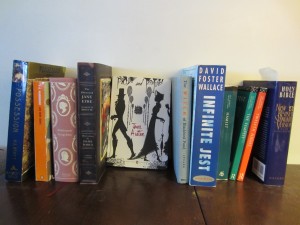
New gap on TBR (To Be Read) shelf:

TBR shelf, sans Baroque Cycle

New residents of AR/IDCTR (Already Read/I Don’t Care To Read) shelf:

Baroque Trilogy on the ABR (already been read) shelf

We did it! My husband and I finished reading Neal Stephenson’s System of the World well before the end of August for my self-assigned Baroque Summer reading project. We read Quicksilver in June, The Confusion in July, and the third volume in Stephenson’s sprawling, insane, erudite and entertaining Baroque Cycle trilogy this month.

SotW continues with main characters Jack Shaftoe, Daniel Waterhouse, and Eliza, duchess of Qwglhm (which Stephenson says is a joke and not meant to be pronounced, but I hear in my head as the Simpson’s Chief Wiggum saying his name, but with a K sound in front of it ending with a mushy r: Kwiggulm”). And there are a host of other characters (Isaac Newton, Princess Caroline, Louis the Sun King) who are almost as entertaining as the ones Stephenson invented.

“Men half your age and double your weight have been slain on these wastes by Extremity of Cold,” said the Earl of Lostwithiel, Lord Warden of the Stannaries, and Rider of the Forest and Chase of Dartmoor, to one of his two fellow-travelers….

“I am astonished that you should call this an extremity of cold,” answered the old man. “In Boston, as you know, this would pass without remark. I am garbed for Boston.”

Stephenson is a huge geek, and the book is about (among many, many things) the rise of finance, philosophy, natural sciences, and computers. If you’ve enjoyed other Stephenson, like Snow Crash or Diamond Age, it’s likely your thing. It also reminded me, in its sprawling, inventive craziness, of David Foster Wallace’s Infinite Jest and Susannah Clarke’s Jonathan Strange and Mr. Norrell. If you liked any of these, and aren’t opposed to doorstoppy books, give the trilogy a look. If not, or if you don’t identify as a geek, this probably isn’t a good fit.

I had a good time reading these as a summer project. They’re so dense it was sometimes hard to keep track of the details and personae, but reading them consecutively and reading along with my husband helped a great deal. I was involved with the characters, learned things from the historic details, was eager to return to the book when I was away from it, and sad to leave it when it was done.

Geeky stats: Trilogy begun 4 June, finished 21 August 2010. Other books read in that time: 12, out of which 8 were graphic novels. Total pages (not including intro and outro material and acks): 2,618.

How long before we succumb to a re-read of Cryptonomicon, which the trilogy is kind of a prequel to? Not long, I bet, though as usual my TBR list is long.

Scott Pilgrim v. 1 to 6 by Bryan Lee O’Malley

Friday, August 27th, 2010

The Scott Pilgrim comic series by Bryan Lee O’Malley is about the 20-something slacker kid of the title and his efforts to woo and win the girl of his dreams, Ramona Flowers. There are many obstacles along the way, like his chaste romance with high schooler Knives Chau, and Ramona’s seven evil exes, whom Scott must defeat in combat. Lucky for him he’s the best fighter in the province. (He’s Canadian.)

I think my favorite is volume 1, since it epitomizes the out-there, wacky visual humor of the entire series, and often made me laugh aloud. My least favorite was volume 3, since it wasn’t as funny. My favorite character was probably drummer Kim Pine (below, left).

Scott Pilgrim

The entire series of six is a fun-filled ride of manga-inspired goofiness that I highly recommend.

Oh, and the movie’s good, too.

Jane Austen’s Fight Club

Tuesday, August 10th, 2010

At Kung Fu Monkey, Jane Austen’s Fight Club. (HT G. Grod.)

Long Live the Colon!

Wednesday, July 14th, 2010

For all my punctuation-geek friends, (of which I know there are many) “Colonoscopy: It’s Time to Check Your Colons” from the Millions (linked from The Morning News):

The jumper colon is a paragraphical Red Bull, a rocket-launch of a punctuator, the Usain Bolt of literature. It’s punchy as hell. To believers of short first sentences–Hemingway?–it couldn’t get any better. To believers of long-winded sentences that leave you gasping and slightly confused–Faulkner?–it also couldn’t get any better. By itself this colon is neither a period nor a non-period… or rather it is a period and it is also a non-period. You choose.

Skype Chat with Victor Lavalle

Thursday, May 20th, 2010

I recently read and loved Big Machine by Victor LaValle, and was lucky enough to attend a Skype chat with him for Minneapolis’ Books and Bars book club. The video is at Mustache Robots, and is worth the ten minutes if you enjoyed the book.

“Howard’s End is on the Landing” by Susan Hill

Monday, May 17th, 2010

My friend A of New Century Reading and I have a semi-regular book swap going now. We lend each other books with overlong library queues, or, in the case of Susan Hill’s Howard’s End is on the Landing, ones that are otherwise not easily available.

I think it was at Pages Turned that I first read about this book, and knew I must read it, then was stunned to find it not at the library, as it’s not (yet) published in the US. I successfully fought down the “WANT IT NOW!” urge to buy it from some site I’ve forgotten the name of (probably for the best) that sells international books for only $25 and no shipping or something, and was thrilled to find that A. had a copy.

Hill is an English author. One day while looking in her shelves for a book she knew she owned, she instead found many unread books, and many more that she had formerly loved and wanted to re-read. Like I’ve done many times, she made a book vow. Unlike me, though, she kept it (or if she slipped, she didn’t admit it in the book.) Hers was to only read from her shelves for a year.

The journey through my own books involved giving up buying new ones, and that will seem a perverse act for someone who is both an author and a publisher…

I wanted to repossess my books, to explore what I had accumulated over a lifetime of reading, and to map this house of many volumes. There are enough here to divert, instruct, entertain, amaze, amuse, edify, improve, enrich me for far longer than a year and every one of them deserves to be taken down and dusted off, opened and read…

There is no doubt that of the thousands of new books published every year many are excellent and some will stand the test of time. A few will become classics. But I wanted to stand back and let the dust settle on everything new, while I set off on a journey through my books.
(p. 2, 3)

The book is both an autobiography of the author’s literary life, including numerous encounters with famous figures in literature. At times I found the name dropping tiresome. But the book overall so engaged me that, like a friend, I accepted it on its merits, which are many. Hill loosely chronicles her year and the books she reads. All of those she writes about are re-reads of favorites, like those of Iris Murdoch or Elizabeth Bowen, or a defense of oft-maligned former favorites, like those by Enid Blyton and Anthony Trollope. She didn’t write about reading any books from her shelves that were new-to-her, however long they’d been sitting.

Hill writes clearly and with affection, both of the books she admires and the people she’s known. Many of the authors she mentioned I knew, but many I didn’t. Reading this was like spending several afternoons in the company of a bookish, learned friend. It reminded me pleasantly of Francine Prose’s Reading Like a Writer. (Heavens, was that really almost four years ago?) The major downside to both of those, though? Now there are so many more authors I want to explore, beyond those already sitting on my shelves.

15 of 15: “Asterios Polyp” by David Mazuchelli

Saturday, May 1st, 2010

I did it! I finished 15 books in 15 days! Woot! And for those of you attempting this folly with me, thank you. For those of you reading along, thank you. For my family, who were even more neglected than usual, thank you.

I encourage everyone who participated in this project to comment. By everyone, I mean those who read 15, those who tried, those who considered it, and those who just read the reviews. What was your favorite, or least favorite? How many books did you move off your TBR shelves? What’s the biggest insight you take away?

And now, last but definitely not least, #15: Asterios Polyp. David Mazzuchelli was the artist/collaborator with Frank Miller on two of my favorite superhero graphic novels, Daredevil: Born Again, and Batman: Year One. Both are classics, and good examples of superhero books for those who dismiss superheroes. Asterios Polyp is Mazzuchelli’s first solo work, and it’s a masterful one. Having just finished it, I look forward to reading it again. It also made me want to read The Odyssey; few books have that power.

Asterios of the title is an Updike-ish architect. Recently divorced, his apartment building is struck by lightning. He grabs three items and his wallet, and takes a bus to the middle of nowhere. The story alternates between the present, where he works as a mechanic in a small town, and the past, his marriage to the artist Hana. Throughout, the art and story focus on duality, yet together they achieve something that transcends either/or.

The art is highly stylized (formalistic, the reviews call it) as is the use of color, playing with variations on cyan, magenta and yellow. Each character has their own font, as well as their own art style. The many layers of artistic variation are dizzying but exhilarating.

Asterios Polyp was just awarded the first-ever LA Times Book Prize for Graphic Novels. For more reviews, check out those from

New York Times
Scott McCloud
Entertainment Weekly
The Comics Journal

And, to sum up my 15/15/15 reading: In Other Rooms, Other Wonders; Shakespeare Wrote for Money; Eats, Shoots and Leaves; Mercury; Chocolate War; Unwritten; Ex Machina: Dirty Tricks; Buffy: Retreat; This is Water; Desperate Characters; Borrowed Finery; The Slave Dancer; Stitches; The Catnappers; Asterios Polyp.

favorite book read: can’t pick just one! Asterios Polyp, Stitches, Catnappers, Slave Dancer, Chocolate War
least favorite books read: Buffy the Vampire Slayer: Retreat and Ex Machina: Dirty Tricks
# of books out of 15 moved off TPR shelves: 14, 5 of which had been there over a year
lesson learned: do this in winter next time–late December or early January
next book: Cutting for Stone by Abraham Verghese
book on deck: Await Your Reply by Dan Chaon
next book project: Baroque Summer

“Batman and Robin” by Grant Morrison

Tuesday, April 13th, 2010

I respect Grant Morrison’s work. But I don’t always get it. I’m fairly certain the deficiency is me, as I’ve read about the zillion obscure-to-me referents he used for whichever book I didn’t care for or understand, like his All-Star Superman. So I approached his take on Batman and Robin, Batman Reborn with trepidation.

From moment one, I was in the driver’s seat, first in the bad guys’ car, then in a Bat vehicle. Morrison tags between these two scenes, and quickly situates us in the Bat-universe:

Robin: I told you it would work. All I had to do was adapt my father’s blueprints.

Batman: I’m sorry I ever doubted you, Damian…

Robin: “Never use real names in the field.” Your words.

Batman: You’re paying attention. Good. You know, I’d have killed for a flying batmobile when I was Robin.

A few pages later, we learn which former Robin is the new Batman, because apparently Bruce Wayne is dead.

I have a passing familiarity with the Bat-universe. I knew who Damian was, and guessed who Batman was, before Alfred confirmed it, though I don’t know who all the Robins have been. This reboot, then, is not only for regular readers of the monthly Bat titles, but also for casual fans of the Bat. It’s quite good, and in the Morrison/Quitely tradition, often gruesome.

There are villains aplenty, like Pyg and the Flamingo, and a new antihero, the Red Hood. The first trade paperback collects issues 1 to 6, but doesn’t resolve everything. Even if you bought the individual issues, the collected edition is a good investment to avoid the ugly, intrusive ads. I look forward to the rest of the series; so far it’s a wild ride.

Upcoming Reading; Care to Join Me?

Friday, April 9th, 2010

So here’s what’s been rattling around in my head:

For now:

15 books, 15 days, 15 blogs
: In honor of the woman profiled in the New York Times last year, who read a book a day for a year and blogged each one, I propose reading a book a day from your shelf starting April 16 (the day after US taxes are due, so you should have a little more time plus be in a frugal mindset) till April 30, 2010 and blogging a review, however brief, the next day.

I would post my entries the night before, so you could link each day starting the 17th in the comments, through May 1, 2010.

Does this sound good to anyone?

I’m afraid coming up with a logo, spreading the word far and wide, and setting up a group on a site like Good Reads is just too much for me, now, though I’m happy to take advice or help on these from more seasoned book challenge folks. I know this is last minute, but that’s me–always running on the ragged edge of disaster. OK, perhaps that’s an exaggeration.

For later:

Call me crazy, but I had a blast last summer reading Infinite Jest, and was thinking of doing something similar: reading Neal Stephenson’s Baroque Cycle, or at least the first two, Quicksilver and The Confusion. They’re each about 900 pages, but so was Cryptonomicon and I loved that and read it at a brisk pace.

Anyone else interested in a Baroque Summer? I’ll probably do it in any case, but it would be way more fun (as Infinite Summer was) with a gang.

Geeking Out: A Game of Thrones at HBO

Tuesday, March 2nd, 2010

TV critic Alan Sepinwall, via Mo Ryan of the ChiTrib, confirms that HBO has given the greenlight to a series based on George R.R. Martin’s fantasy novel A Game of Thrones.

The cast includes some impressive names, like Mark Addy of Shaun of the Dead, Jennifer Ehle of Pride and Prejudice, and Lena Headey of 300 and the Terminator tv series, but I was most surprised and delighted to see that David Benioff, whose City of Thieves I just finished and loved, is the Exec Producer and screenwriter.

A Game of Thrones was recommended to me in 1997 by two of my co-worker friends at a comic shop in Bryn Mawr, PA. I devoured it and passed it on to my then-boyfriend G. Grod, who also devoured it. We liked the 2nd book, but were disappointed that the third wasn’t the conclusion, and I never made it through. I wished for far less description of what people were wearing (sumptuous velvets embroidered with sigils) and what people were eating (savory meat in delicious sauce, and no vegetables; how did these people not get scurvy?) and more of the story and characters. I’ve been thinking for a while I’d like to revisit the series if Martin ever finishes the fifth book, so I don’t end up a victim of waaaant! because of the series’ IWantToReadItosity like Jo Walton at Tor.com. Now I’ve got even more incentive.

Less vs. Fewer

Friday, February 19th, 2010

Even though I know the difference, I made this grammar mistake recently, and thought it merited re-posting.

Use the word less for uncountable items: I ate less Jell-o than he did.

Use fewer for items you can count: I ate fewer French fries than she did.

This means that every single sign in stores that reads “x items or less” is incorrect. Instead it should read “x items or fewer,” as Mrs. Incandenza campaigned for in David Foster Wallace’s Infinite Jest.

Related: the same rule holds for amount and number. Use amount for things that can’t be counted, like water, and number for things that can, like people.

“Ender’s Game” by Orson Scott Card

Thursday, February 11th, 2010

This week’s selection for Books and Bars, Orson Scott Card’s Ender’s Game, is a sci-fi classic. It won both the Hugo and the Nebula awards when it came out. The short story it grew out of was published in 1977, the same year Star Wars came to theaters. Card expanded the story to a novel, published in 1985. Ender, a nickname for Andrew, is not unlike Luke Skywalker, or any number of other mythical heroes whose story follows what Joseph Campbell called a monomyth in The Hero with a Thousand Faces:

A hero ventures forth from the world of common day into a region of supernatural wonder: fabulous forces are there encountered and a decisive victory is won: the hero comes back from this mysterious adventure with the power to bestow boons on his fellow man.

Ender’s Earth was attacked and almost destroyed twice within the last century by an alien race, called “buggers.” Since then, peace has existed among the countries. Children are monitored for excellence, and a very few are selected for the International Fleet’s battle school. Ender Wiggin is 6 years old. He’s a third child, a rarity, and something not allowed for most people on Earth. His parents were not only allowed, but encouraged to have a third child, after his older brother, Peter, proved a brilliant sociopath and his sister, Valentine, too pacifistic. In conversations between the military adults that preface each chapter, readers learn that Ender is a hoped-for synthesis of his siblings: brilliant and strong and empathic.

As Ender progresses through battle school, he is faced again and again with challenges, some of which are situational, and many of which are manufactured as the adults try to manipulate him into the military leader they hope him to be. Peter and Valentine, meanwhile, take on a challenge of their own when the fragile peace on Earth is threatened. They patiently and thoroughly build reputations for themselves online as political commentators known by the pseudonyms Locke (Peter) and Demosthenes (Valentine). Both siblings continue to affect Ender throughout his education. Peter is the violent killer Ender fears he has become, and Valentine is twice manipulated into urging Ender on in his training.

The book is a chilling meditation on the power adults have over children in the control of environment and information. It also ponders the relation between the military and the state, and what each person owes, or doesn’t, as a citizen. Ultimately, it wonders what it takes to be a killer, and whether killing is an inevitable result, whether out of fear, self-preservation or power. Card’s thorough and complex characterizations of Ender and his siblings, as well as the momentum created by a strong plot, make this an engrossing and provocative read for fans of science fiction and heroic myths, like the Harry Potter saga.

I am assured by fans of the series that the sequel, Speaker for the Dead, not only equals but surpasses and completes the saga begun in Ender’s Game. It, too, won both the Hugo and Nebula awards, the year after Ender’s Game did. There are several more books in the Ender tale, and some about other characters.

2010 Tournament of Books is here!

Tuesday, January 12th, 2010

At The Morning News, they’ve published the short list of 16 novels for the literary March Madness Tournament of books.

The Year of the Flood, by Margaret Atwood
The Anthologist, by Nicholson Baker
Fever Chart, by Bill Cotter
Logicomix: An Epic Search for Truth, by Apostolos Doxiadis
The Book of Night Women, by Marlon James
The Lacuna, by Barbara Kingsolver
Big Machine, by Victor Lavalle
Let the Great World Spin, by Colum McCann
Wolf Hall, by Hilary Mantel
A Gate at the Stairs, by Lorrie Moore
Miles from Nowhere, by Nami Mun
That Old Cape Magic, by Richard Russo
Burnt Shadows, by Kamila Shamsie
The Help, by Kathryn Stockett
Everything Ravaged, Everything Burned, by Wells Tower
Lowboy, by John Wray

The long list had some puzzling exclusions, like Jeff in Venice; Death in Vanasi, and In Other Rooms, Other Wonders, both of which were on my to-read list from last year. The jump from long to short has me puzzled as well. I’m disappointed these didn’t make the cut: Await Your Reply, Dan Chaon, Trouble, Kate Christensen, The Believers, Zoe Heller, Chronic City, Jonathan Lethem, The City & The City, China Mieville, Lark and Termite, Jayne Anne Phillips, This Is Where I Leave You, Jonathan Tropper, and The Little Stranger, Sarah Waters. All these sounded promising to me when they came out last year.

Further, I’m stymied by the inclusion of these: Fever Chart, Bill Cotter, The Book of Night Women, Marlon James, Miles from Nowhere, Nami Mun, and Burnt Shadows, Kamila Shamsie. These, over the ones in the previous paragraph?

Finally, I’m not thrilled to see either Lorrie Moore’s A Gate at the Stairs or Russo’s That Old Cape Magic. Neither are supposed to be the writer at the top of her/his game, so I can’t get excited to read them.

That said, I AM excited to try and read as many as I can of these, all of which I’ve heard good things about: The Year of the Flood by Margaret Atwood, The Anthologist by Nicholson Baker, Logicomix: An Epic Search for Truth by Apostolos Doxiadis, The Lacuna by Barbara Kingsolver, Big Machine by Victor Lavalle, Let the Great World Spin by Colum McCann (also a selection of Books and Bars), Wolf Hall by Hilary Mantel (which lit friends Amy R and Kate F both liked), The Help by Kathryn Stockett, Everything Ravaged, Everything Burned by Wells Tower, and Lowboy by John Wray.

I’m off to put some books in my queue at the library. Who’s going to be joining the fray?

Clever Cupcakes

Thursday, January 7th, 2010

I love cupcakes. I love clever. This series of 100 celebrates the world of games/gaming. The link from Wil Wheaton’s blog urges you to go, and I’m glad I did. I was delighted several times, and I bet you will be, too.

Scrabble cupcake

Happy 2010!

Monday, January 4th, 2010

A good book, a cup of coffee, a manageable to-do list, and Stella D’oro breakfast treats, courtesy of my kind mother-in-law, since I can’t find them anywhere out here.

New Year's Day 2010

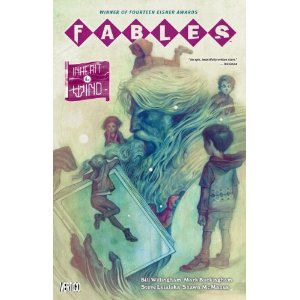
“Peter and Max: a Fables Novel” by Bill Willingham

Saturday, December 19th, 2009

As with The Wild Things, I’m suspicious of novels based on other mediums; I’ve been disappointed too many times. But when I asked C, the second-in-command at Big Brain Comics, what he thought of Peter and Max by Bill Willingham, he replied that he picked it up and a long time later realized he’d been reading one of the best Fables stories in the series, and it wasn’t even the comic book.

Fables is an ongoing monthly comic from DC/Vertigo, written by Bill Willingham and mostly illustrated by Steve Leialoha. It posits a small neighborhood in NYC where storybook characters live in exile, and a farm in upstate New York where the animal and other nonhuman storybook characters live in seclusion. It’s won scads of awards, and is a complex, entertaining series in the tradition of Neil Gaiman’s Sandman. I recently enjoyed the twelfth graphic novel collection, The Dark Ages.

Peter and Max is a standalone novel about Peter Piper and his brother Max, who live in the land of Hesse:

The caravan belonged to the Piper family who, as their name implied, were traveling musicians., Just as Millers mill and Fletchers fletch, the Pipers piped. At least three out of four of them did. The father, Johannes, and his two sons, Max, the eldest and young Peter, all played the long pipe, which was sometimes called the single pipe, or occasionally even the flute as it was still known back then, before some enterprising soul came along later and decided all true flutes should be turned sideways to play…

The family had no home, except for their wagon. They lived the life of happy vagabonds, traveling here and there, throughout the year, going to festivals and fairs, and every other sort of scheduled celebration, where they’d make their living by letting anyone call the tune, provided they were willing to pay the Pipers. (38-9)

They are staying with their friends the Peeps when Hesse is invaded by the emperor’s goblin troops. The families flee for the town of Hamelin through the black forest, but soon are separated when Max’s jealousy of Peter takes a serious turn.

The novel alternates between modern time and the past as Peter and Max take separate but always intertwined paths. It’s set before the Fables/Empire war in the series’ time line. Both stories have fierce momentum that drive the past and present stories to a satisfying conclusion. The novel is well illustrated by Leialoha in black ink, which adds to the storybook feeling, as does the violent content, consistent with fables of old.

I found this a great addition to the Fables oeuvre, with many takes on legends involving Peter, pipers, and the Peeps. It would also be good for those unfamiliar to the Fables comic-book series, as an introduction to the series, especially for those not yet familiar with the complex literary and visual joys of the comic-book medium. Highly recommended.

How to Heat a Pan

Tuesday, December 15th, 2009

At Houseboat Eats, which I’ll presently be adding to my subscription list, author Talley writes “On properly heating your pan.” Be sure to watch the embedded video. I hesitated a bit about following the link from The Morning News, but holy cats, I’m glad I did. The video is fascinating, and I can’t wait to try it tonight when I cook tofu.

“American Madness” (1932)

Thursday, November 12th, 2009

I finally made it to a showing at the Trylon microcinema in south Minneapolis. It’s owned and run by Barry Kryshka of Take-Up Productions. With an entry through an art gallery, it’s a sweet little space, and Frank Capra’s American Madness was a sweet little little film to see there.

Walter Huston (director John’s father, and Angelica’s grandfather) is Thomas Dickson, a bank manager who provides loans or withholds them based on hunches and a person’s character. In the financially volatile 1930’s, this drives the bank board nuts, and they try to oust him. The plot takes a guy with a gambling problem, the mob, a neglected wife, and a few nice guys, and mixes it all to good effect. It’s funny, clever and touching with some striking images, particularly of a run on the bank.

The Trylon shows two films, about 7 and 9, on Fridays and Saturdays. It’s near Midori’s Floating World or the Town Talk Diner for dinner, or Glaciers Cafe for frozen custard before or after. The Trylon has good popcorn with real butter, with a good selection of beverages and candy. They just published their winter schedule, December is Powell/Pressburger films (”The Archers“), January is Johnny Depp and February is Godard. They’ll also have a Brit-noir series at the Heights that runs December through March.

Off the Wagon

Wednesday, November 11th, 2009

3yo Guppy and I had some time to kill before his dentist appointment this morning. I know I always say I need to read more of what I’ve got rather than buying new or used, but these fairly flew off the shelves at me, crying, “Take me home! Home!”

So I did.


Little Black Book of Stories
by A.S. Byatt
The Unpossessed by Tess Schesinger, which I saw reviewed in Vogue years ago, and wanted ever since
Expletives Deleted and Nights at the Circus (look at the gorgeous covers!) by Angela Carter
Rebecca by Daphne DuMaurier, which I recently realized I didn’t own, and thus promptly corrected.

“Daredevil: Born Again” by Frank Miller and David Mazzucchelli

Friday, October 30th, 2009

Prompted by a recent article at The Comics Reporter (link from The Morning News) on the collaboration between comic book writer and artist, I pulled my copy of Daredevil: Born Again off the shelf. It’s written by Frank Miller and illustrated by David Mazzucchelli. Even at twenty plus years old with garish colors, it remains undiminished as a classic of the superhero genre.

It opens on a skinny, defeated-looking woman hunched over a cigarette in a smoky room with a smug-looking man:

It’s a hot day. Like all the rest. All two years of them. Two years… and the motion picture epic that turned into just another come-on isn’t even a memory…like all the rest except this one has a special glow to it. It’s not every day you sell your soul. That’s not way to think. Grow up. It’s the eighties. You do what you have to. And you have to do it…

“Daredevil. Okay? I said it. I said the name. And he’s got another name. And it’s written down right here. You want it or not?

Matt Murdock’s ex-girlfriend, Karen Page, is a junkie now, and she sells his name for a fix. It gets back to his nemesis, the Kingpin, who systematically breaks down and takes away all support in Murdock’s life until he’s not only on the edge, he’s gone so far beyond it that no one knows if he’s coming back. While the title kind of gives the ending away, it’s the marriage of words and pictures, and how they detail Murdock’s fall and resurrection (in all its Catholic imagery) that compelled this reader through the book.

The recent runs of Brian Michael Bendis and Ed Brubaker got a lot of kudos from the critics. But their artistic collaborators (Alex Maleev, who largely made the Bendis run, IMO, and Michael Lark with Brubaker) are hardly mentioned, and often not named on the covers of the collections. Ng Suat Tong’s collaboration article makes a good point. If a writer writes a decent script, and an illustrator draws well, you get a good story, sometimes even a very good one, as when Bendis and Maleev worked together. But only when there’s a true collaboration, and the writer and artist are working together, and both bringing more to it than each could individually, do you get a great work, a classic, like this one. And to give a collaborating artist second billing, or no billing, as noted by Tong, “should be cause for consternation if not disgust.”

This was not the case with Born Again, on which Mazzucchelli receives equal billing with the much-more-famous Miller. Mazzucchelli is receiving his own share of praise this year for his first solo work, the graphic novel Asterios Polyp.